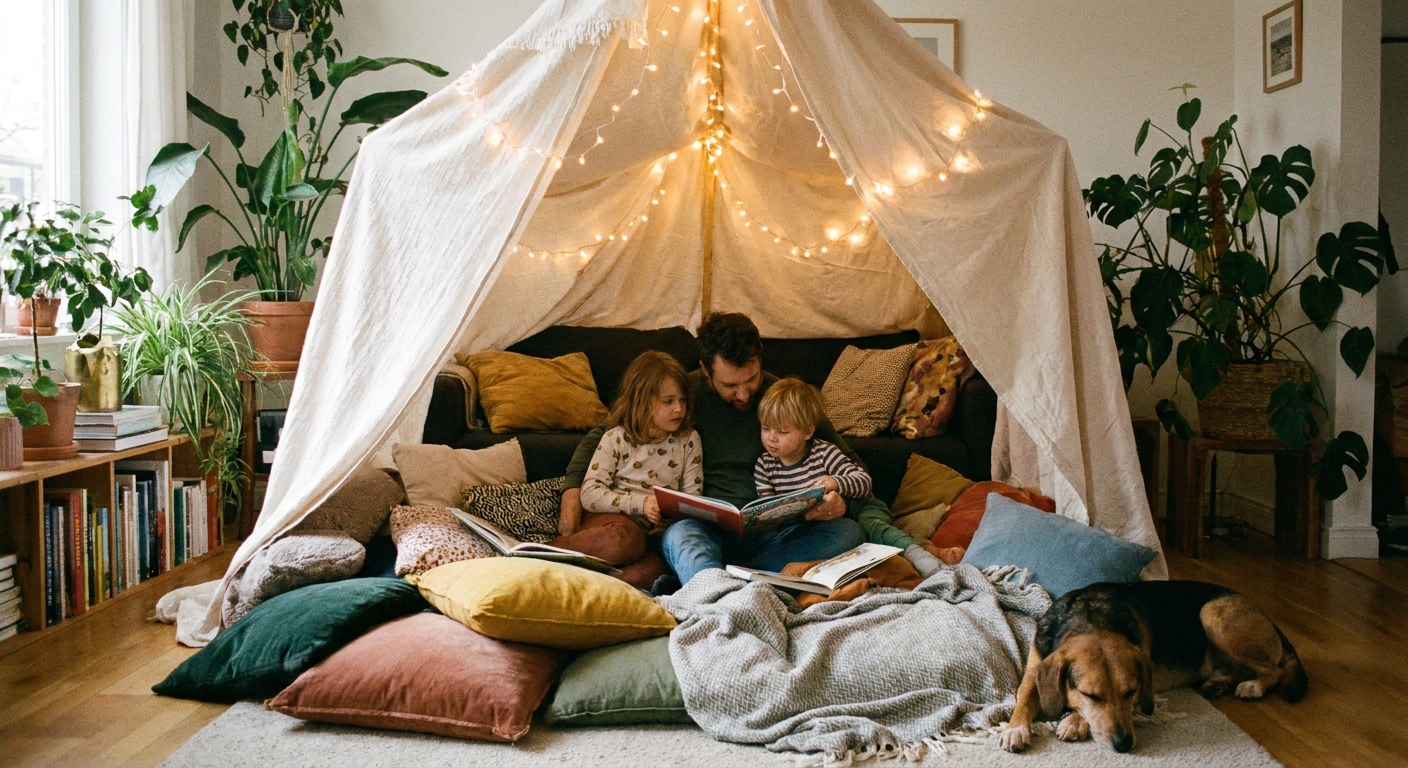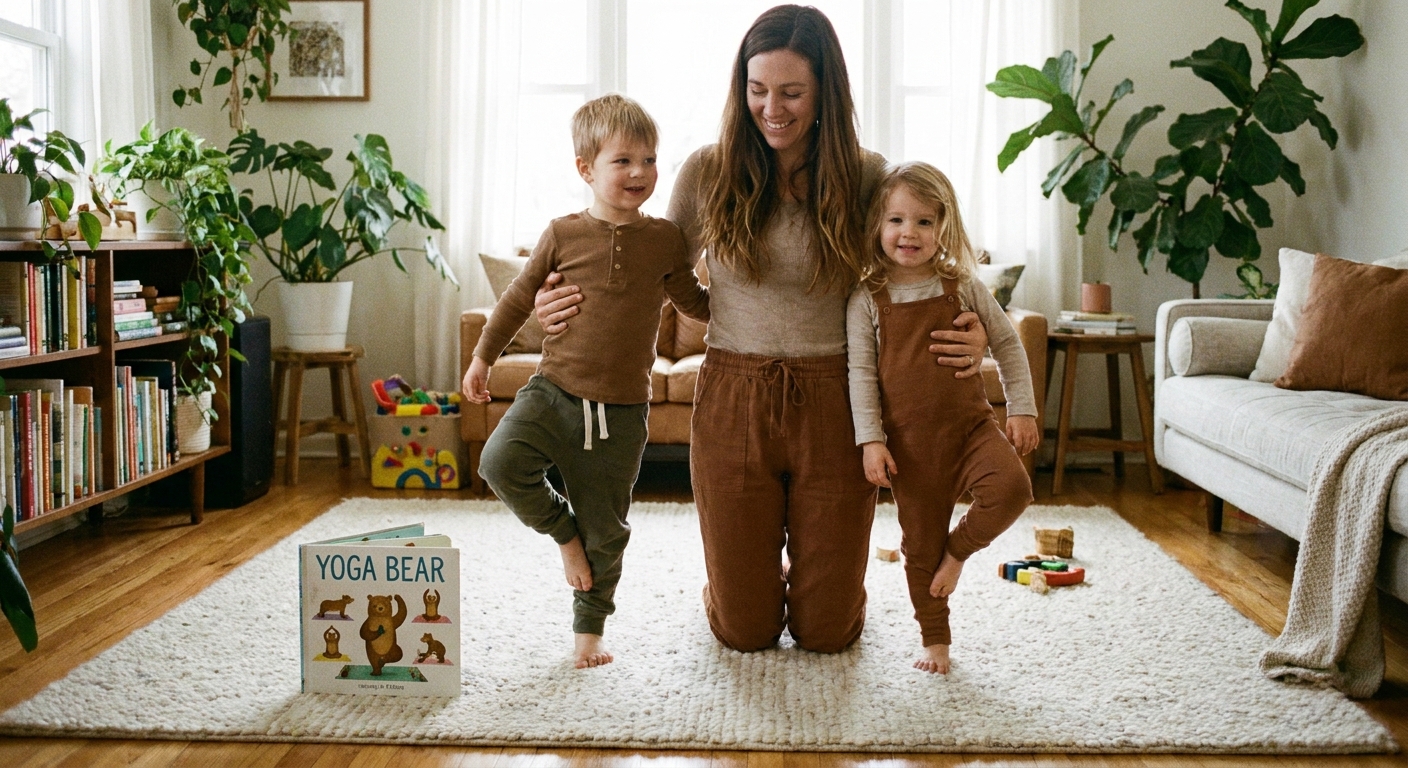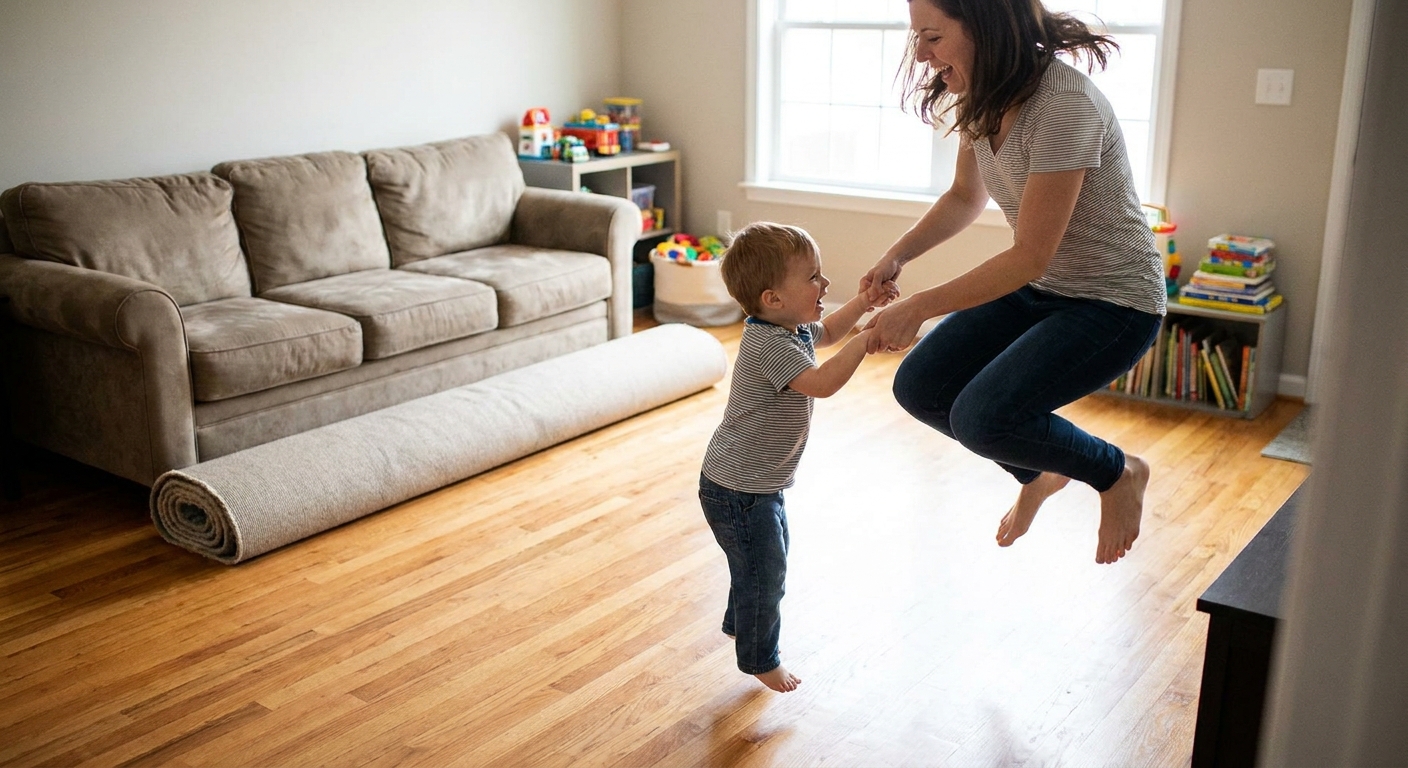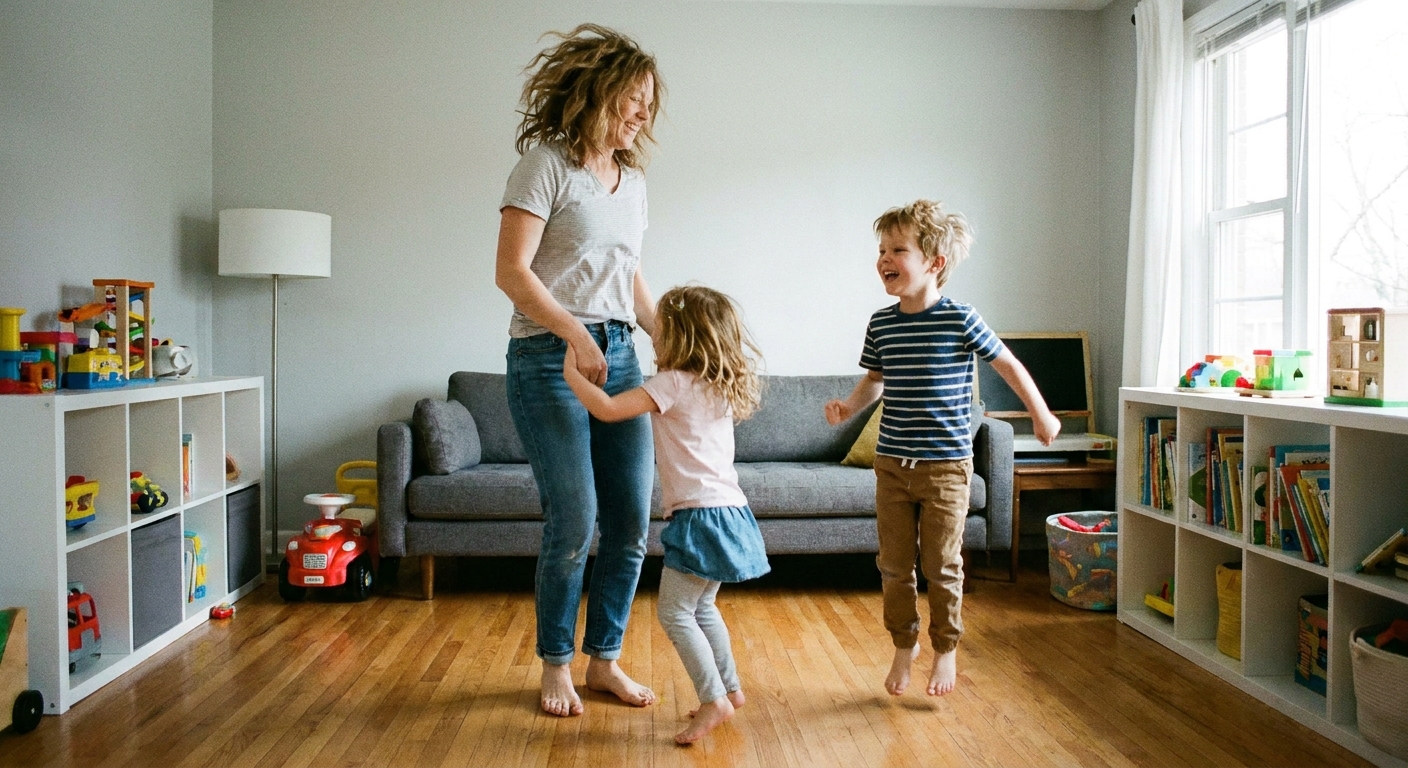

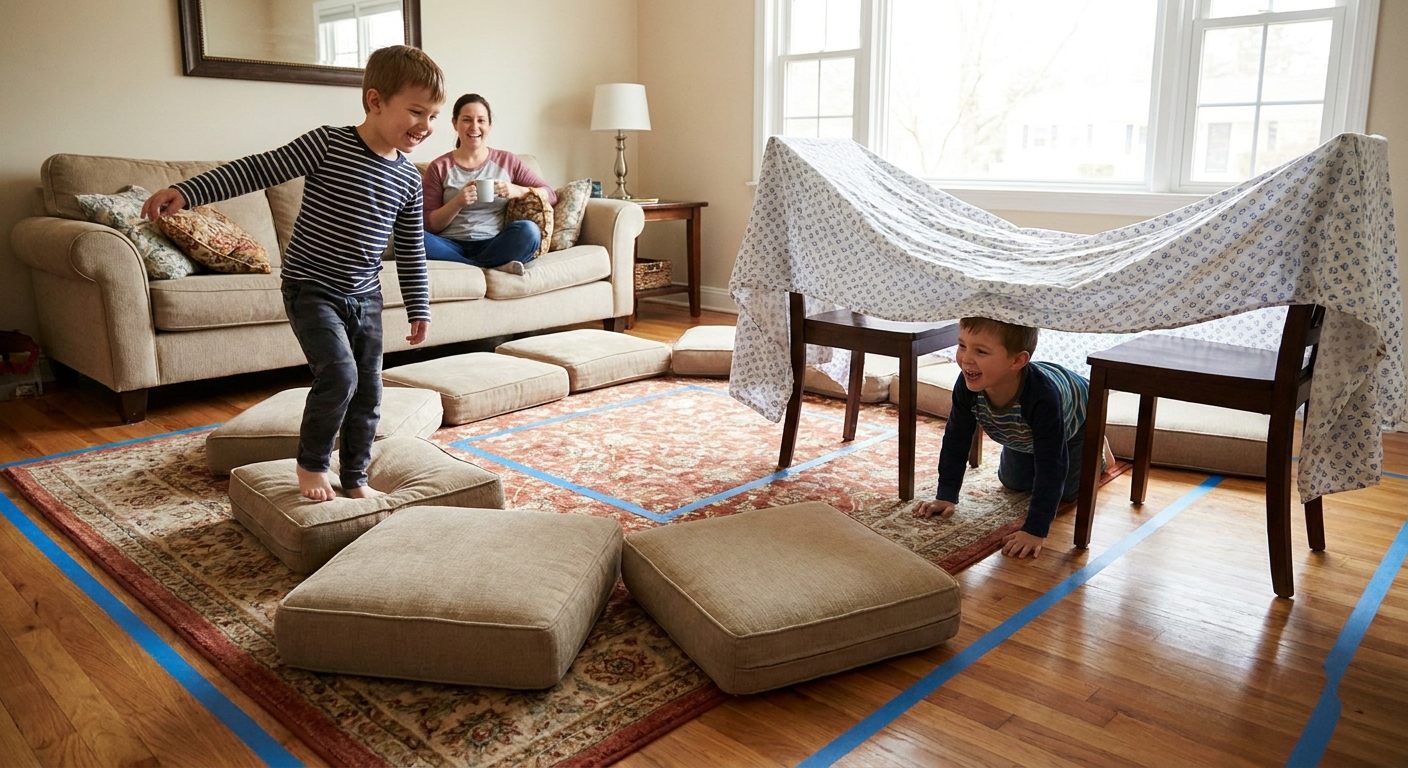
One rainy afternoon, I watched my kids turn our hallway into a “river,” our couch into a “mountain,” and my good throw blanket into a “dragon’s cave” in about four minutes flat. No fancy gear. No perfect plan. Just a story they loved and the kind of wiggly energy that simply has to go somewhere.
That is my favorite kind of family activity: a little reading, a little pretending, and a lot of joyful stomping. Here is how to build an indoor obstacle course inspired by classic children’s books, with stations that feel like you stepped right onto the page.
Start with one book
You do not need to recreate an entire plot. Pick a book your family already knows well and choose one big feeling from it:
- Brave (cross the bridge, face the “storm”)
- Sneaky (tiptoe past the “sleeping giant”)
- Helpful (deliver the “letter,” rescue the stuffed animal)
- Curious (search for clues, crawl into a “burrow”)
That feeling becomes your theme, and the stations basically write themselves.
Safety first
I love a dramatic quest as much as anyone, but indoor courses need gentle rules. Here is my quick safety sweep before we begin:
- Clear the runway. Move coffee tables, floor lamps, toy bins with sharp corners, and anything wobbly.
- Choose “soft wins.” Use couch cushions, pillows, stuffed animals, painter’s tape, and blankets. Skip chairs for little kids.
- Make a no crash zone. Keep the course away from stairs, fireplaces, and glass.
- Shoes off. Bare feet or grippy socks help prevent slips.
- Check the floor. Smooth down bunched rugs, watch for slippery throws, and tape down anything that slides.
- Watch the course. A parent should stay within arm’s reach for toddlers and any station that involves jumping or crawling under fabric. Also, keep an eye out for pets underfoot.
- One at a time. This cuts down on most sibling pileups.
- Use the two-sentence rule. Each station gets a simple cue like “Step on the lily pads” or “Crawl through the cave.”
If you have toddlers, keep everything low to the ground and build more “crawl, step, toss” than “jump, climb, sprint.”
Simple supplies
You can do this with what you already have. I usually pull from a small basket and do not overthink it.
- Painter’s tape or masking tape
- Couch cushions and pillows
- Blankets (for tunnels and “rivers”)
- Paper plates (stepping stones or targets)
- Stuffed animals or action figures (characters to rescue)
- A laundry basket (boat, wagon, treasure chest)
- Index cards or paper scraps (clues, “maps,” challenge cards)
If you want a quick crafty add-on, paper props are perfect. Our paper scene activity uses the same idea of building a story world from simple materials.
5 station types
Most book-inspired obstacle courses are just a mix of these five station types. Choose 4 to 8 stations depending on attention span and space.
1) Cross the “river”
- Setup: Lay a blanket on the floor as the river. Place cushions or paper plates as stepping stones.
- Challenge: “Do not touch the water.”
- Make it bookish: Call them lily pads, ice floes, or pirate planks.
2) Crawl through the “tunnel”
- Setup: Drape a blanket over two couches, a sofa and an ottoman, or a row of pillows.
- Challenge: Crawl quietly, carry a stuffed animal, or crawl backward for big kids.
- Make it bookish: Bear cave, rabbit hole, secret passage, subway tunnel.
3) Balance along the “bridge”
- Setup: Make a tape line on the floor, or lay down a scarf as a path.
- Challenge: Heel to toe walk, or walk while holding a “magic egg” (ball of socks) without dropping it.
- Make it bookish: Troll bridge, jungle vine path, tightrope in the circus.
4) Toss the “treasure”
- Setup: Use a laundry basket as the target. Toss rolled socks or beanbags.
- Challenge: Three tries, then move on.
- Make it bookish: Feed the very hungry creature, return lost stars to the sky, deliver letters to the castle.
5) Act it out
- Setup: Put a card at the station with a quick action.
- Challenge: Hop like a frog, stomp like a giant, tiptoe like a mouse, flap like a dragon.
- Make it bookish: Choose an action your main character does in the story.
Want to sprinkle in singing to keep kids moving between stations? Action songs are pure gold for pacing. I keep a few favorites handy from classic action songs for preschoolers.
Book to course ideas
Below are flexible “inspired by” setups that fit lots of well-loved classics. The goal is to echo the story, not perfectly reproduce it.
Where the Wild Things Are: Wild Rumpus Circuit
- Vine swing: Tape line zigzag to follow without stepping off.
- Monster stomp: 10 big stomps on a pillow “island.”
- Howl corner: Do one silly roar into a pillow.
- Sail home: Sit in a laundry basket “boat” and scoot with feet to the finish.
The Very Hungry Caterpillar: Snack Hunt Path
- Egg to leaf: Step on paper plates in color order.
- Food tunnel: Crawl through a blanket tunnel to “munch” (collect) felt play food or paper circles.
- Cocoon: Wrap up in a blanket for five slow breaths, then “butterfly out.”
Harold and the Purple Crayon: Drawn World Course
- Crayon road: Tape a winding line to follow.
- Draw a bridge: Kids add a tape “bridge” piece to cross the river station.
- Moon landing: Jump from cushion to cushion and touch a paper “moon” on the wall.
We’re Going on a Bear Hunt: Texture Trail
- Swishy grass: Walk through streamers or ribbon wands. If you want a fast DIY, our sensory ribbon wands are perfect for this.
- Squishy mud: Step on couch cushions.
- Dark cave: Crawl through the blanket tunnel with a flashlight held by a parent.
- Run back: Repeat the course in reverse, a little faster.
Caps for Sale: Monkey Mischief Course
- Balance caps: Carry a small stack of washcloths or soft hats from one end of the room to the other.
- Copycat corner: Parent makes a pose, kids copy it exactly.
- Return the caps: Toss washcloth “caps” into a basket.
If your crew loves animal characters, you can pair the course with a quick sing-along from animal nursery rhymes for early speech while you reset the stations.
Set it up fast
This is my living room method. Once you have done it once, it really can come together in about 10 minutes. The first time might take a little longer, and that is completely fine.
- Pick the route. A loop works better than a dead end. Living room to hallway to living room is plenty.
- Place your “soft anchors.” River blanket, tunnel blanket, cushion stepping stones.
- Add one skill station. Toss target or balance line.
- Add one imagination station. A quick character action like “tiptoe past the giant.”
- Do a parent test walk. If you feel wobbly, it is too wobbly.
- Explain the story in 30 seconds. “We are traveling to the castle. The river is first. Then the cave. Then we feed the dragon.”
Then you start. Perfection is not invited. Joy is.
Adjust for ages
Toddlers (1 to 3)
- Keep stations low and slow.
- Do 3 to 5 stations total.
- Swap “do not touch the water” for “step on the pillows.”
- Use stuffed animals as the “goal” to carry through.
Preschoolers (3 to 5)
- Add simple rules: “Two feet on each stone.”
- Let them help build one station.
- Introduce pretend obstacles: sleeping dragon, sticky mud, windy bridge.
Big kids (6+)
- Add time challenges, but keep it friendly.
- Use “chapter cards” with small tasks: spell a word, find a hidden clue, do 10 jumping jacks.
- Let them design a station for a younger sibling.
Mixed ages
My favorite trick is the “buddy rule”: an older child goes first and shows the station, then a younger child goes with a simplified version. Everybody feels important. Nobody gets steamrolled.
Cozy add-ons
- Character tickets: Hand each child a paper “ticket” to the adventure that they stamp (a crayon scribble) at each station.
- Soundtrack: Add a drum beat for marching or creeping. Our coffee can hand drums are wonderfully sturdy for this.
- Story ending: Finish with the last page of the book on the couch, everyone bundled up, hearts thumping.
Troubleshooting
“My kids get too wild.”
Start with a whisper challenge. “The dragon is sleeping. Can you do the whole cave tunnel quietly?” Quiet games feel like magic and naturally slow bodies down.
“We do not have much space.”
Make it a hallway course: tape line balance, one tunnel (blanket over pillows), one toss target at the end. Then walk back and repeat.
“They keep arguing about whose turn.”
Put a stuffed animal in charge. Whoever holds the “story buddy” is the next adventurer. When they finish, they hand the buddy to the next child.
“I need a calmer version for bedtime.”
Turn it into a slow “story walk.” Step on the stones, crawl through the tunnel, then end with a lullaby and a cuddle. If that is your season, you might like these calming bedtime songs.
“Cleanup feels like too much.”
Make one laundry basket the official “prop boat” and toss everything in as you go. If you want a gentle reset, sing a quick tidy-up song while you fold the river blanket. Our transition songs for tidy-up time are made for exactly this moment.
From my kitchen table
The obstacle course is not the point. The point is that your child sees their favorite story spill out into the real world, right there in your living room, with you cheering from the “castle gates” (also known as the rug).
If you try one, I hope you let it be a little messy, a little silly, and completely yours.
For more cozy, low-prep ideas like this, you can browse our Family Activities guide.