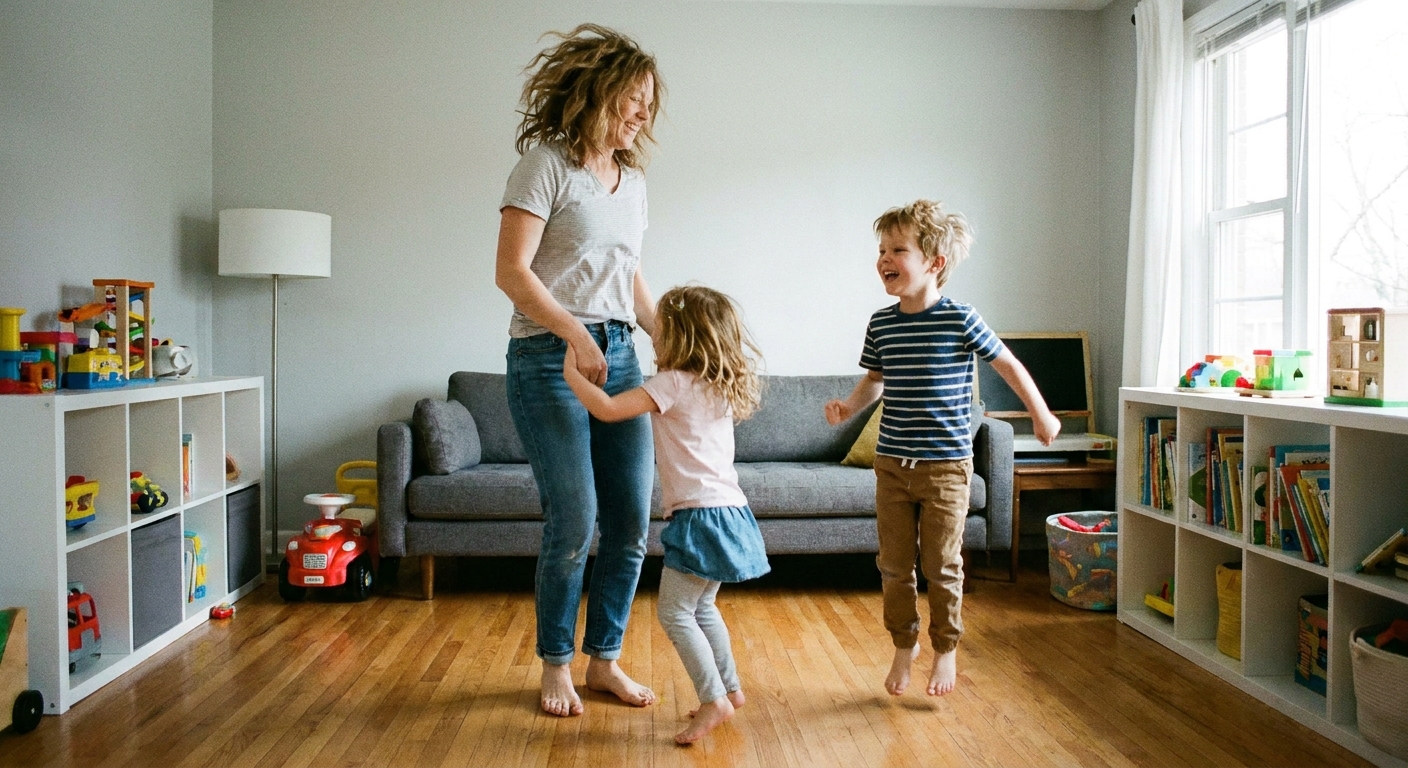

When my kids were little, I learned a funny truth: if you ask a wiggly child to “calm down,” you usually get more wiggles. But if you hand them a rhyme and a job for their feet, suddenly all that energy has somewhere useful to go.
This is my go-to collection of high-energy nursery rhymes for building gross motor skills like balance, coordination, hopping, marching, crossing the midline, and stopping on cue. No fancy equipment required, just a safe space and a grownup willing to be a little silly.
Before you start: a quick safety setup
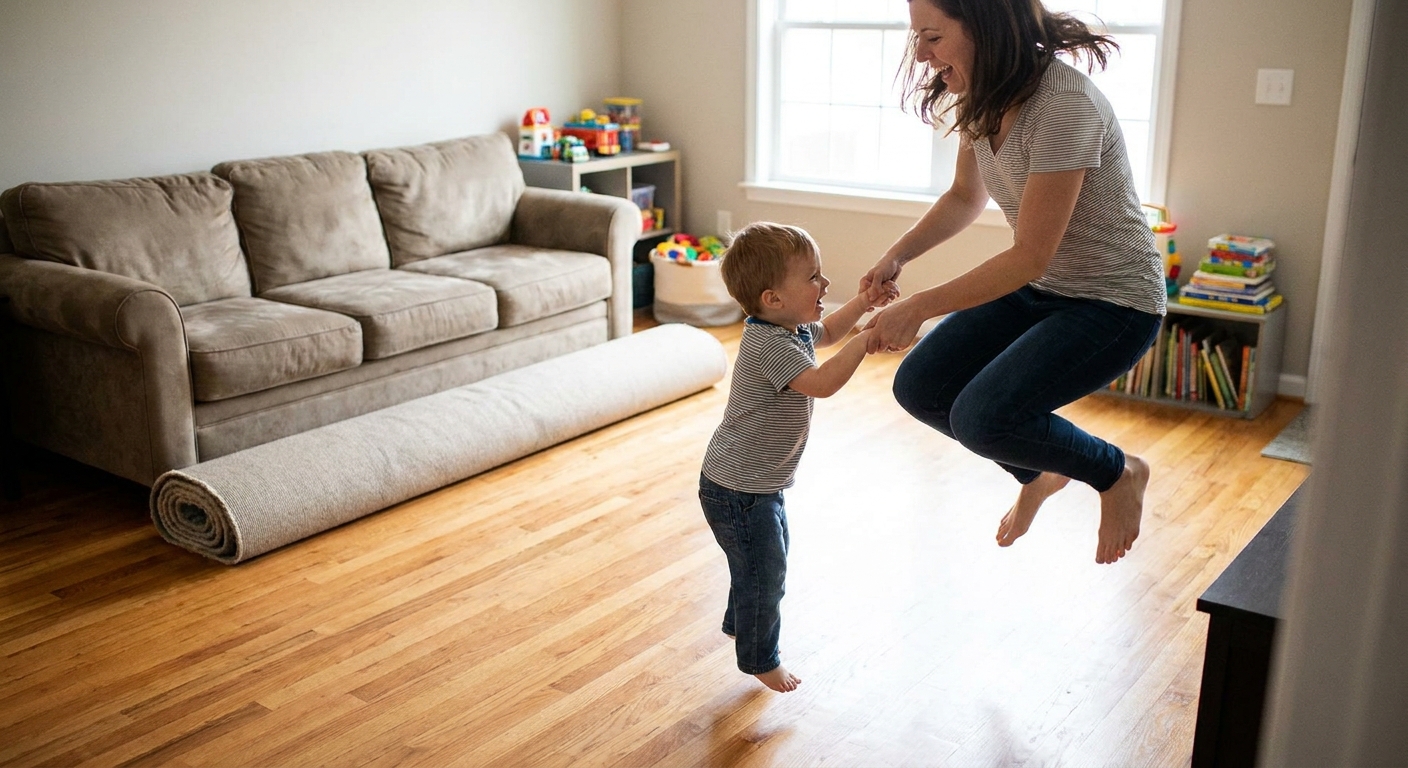
I like to do a 30-second “room sweep” so everyone can move big without bonking into anything.
- Clear the runway: Scoot coffee tables, baskets, and toy bins to the edge.
- Choose the right surface: Carpet or a rug is friendlier for jumping. For hard floors, keep jumps smaller.
- Socks check: If socks are slippery, go barefoot or use grippy socks.
- Give boundaries: Use painter’s tape or a scarf to mark “your dancing spot.”
- Keep it short: For toddlers, 3 to 8 minutes is often a great starting point. You can always do a second round later.
If you want more everyday rhyme ideas beyond high-energy play, our Nursery Rhymes guide is a cozy place to wander.
The best high-energy nursery rhymes (and what they build)
Below you will find each rhyme with simple movement prompts. You do not have to do every move. Pick one or two, repeat the rhyme, and let your child’s body take it from there.
1) Head, Shoulders, Knees, and Toes
Best for: coordination, body awareness, crossing the midline, speed changes
How we move: Touch each body part. Repeat faster. Then, for older toddlers and preschoolers, try a “crisscross” version like right hand to left knee, then left hand to right shoulder.
Make it a gross motor challenge: Do it in a wide squat, then on tiptoes, then with a gentle march.
2) If You’re Happy and You Know It
Best for: following directions, rhythm, start-and-stop control
How we move: Clap. Stomp. Jump. Spin. Reach high. Touch the floor. March. Freeze.
My favorite twist: Add “If you’re happy and you know it, freeze like a statue.” That stop on cue is real motor skill gold for practicing stop-start control and early impulse control.
3) Hokey Pokey
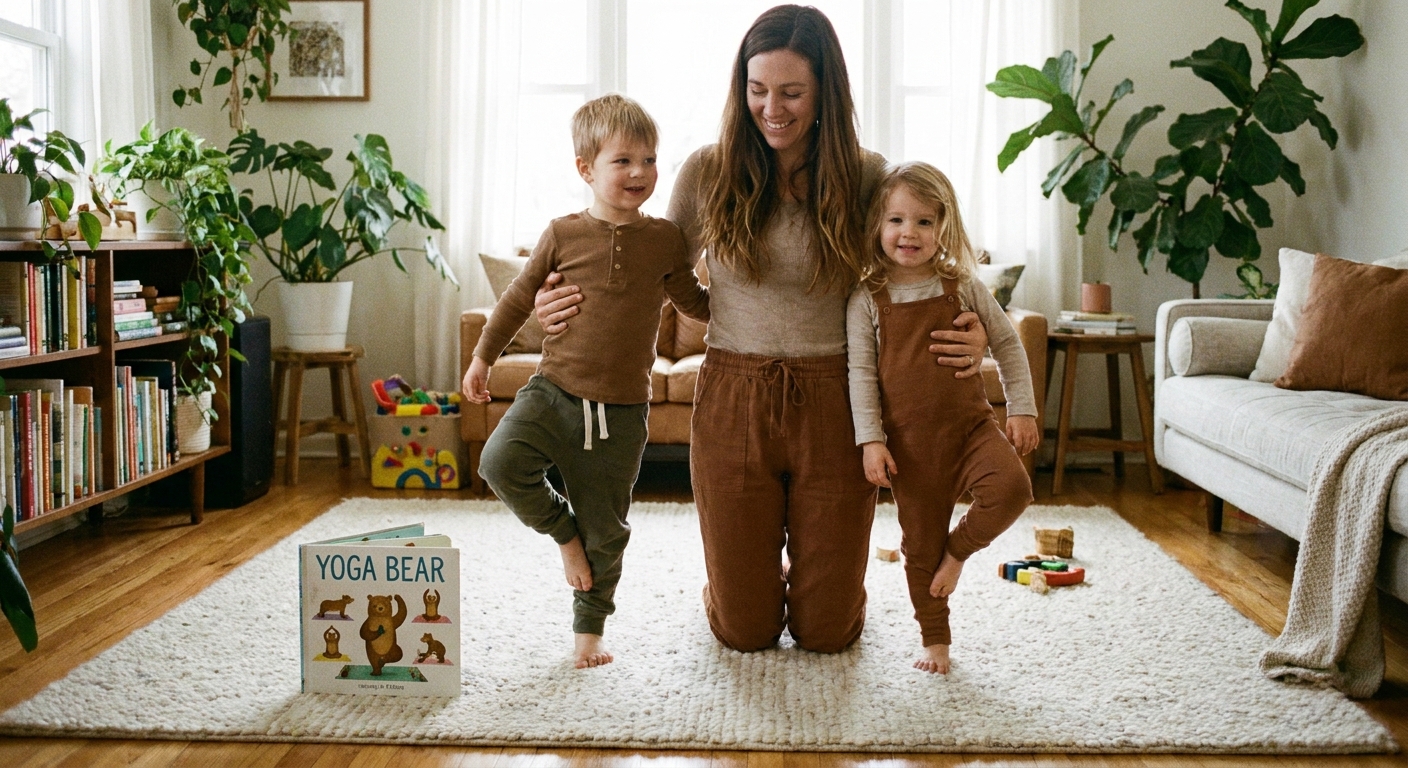
Best for: balance, one-leg control, left-and-right awareness, turning
How we move: Put one hand or foot in. Put it out. Put it in. Shake it all about. Then turn yourself around.
Make it easier: For toddlers, skip left and right and just name the body part.
Make it harder: Hold the “in” position for three seconds before shaking.
4) Ring Around the Rosie
Best for: circular walking, timing, safe sitting down and standing back up
How we move: Hold hands in a circle and step together. On “we all fall down,” practice a controlled sit (hands to the floor first if needed), then stand back up.
Gross motor boost: Try a second round where you tiptoe, then a round where you take giant steps.
5) Here We Go Looby Loo
Best for: marching, turning, coordination, imitation
How we move: Put your right hand in. Shake it. Shake it. Shake it. Then turn yourself about. Repeat with other parts.
Why I love it: It is like a simpler cousin of Hokey Pokey, which makes it perfect for younger toddlers.
6) The Wheels on the Bus
Best for: shoulder stability, big arm circles, core engagement
How we move: Make big arm circles for wheels. Sway side to side for wipers. Push “open” and “shut” for doors. Bounce like babies. Squat up and down for people.
Make it a full-body circuit: Each verse is a different move. Repeat your child’s favorite verse three times like a mini workout.
7) Teddy Bear, Teddy Bear (Turn Around)
Best for: jumping, turning, balancing, following multi-step directions
How we move: Turn around. Touch the ground. Jump up high. Touch the sky. Bend down low. Touch your toes, and so on.
Tip: If turning revs your child up too much, swap “turn around” for “march in place.”
8) This Is the Way We Wash Our Hands (and more)
Best for: coordinated movement patterns, pretend play, motor planning
How we move: Act out “wash,” “dry,” “comb,” and “brush.” Then switch to big-movement chores: sweep the floor, scrub the table, carry the laundry.
Natural add-on: Pair it with our transition songs for tidy-up time when you want all that motion to end somewhere helpful.
9) London Bridge Is Falling Down
Best for: timing, ducking, spatial awareness, confidence moving through obstacles
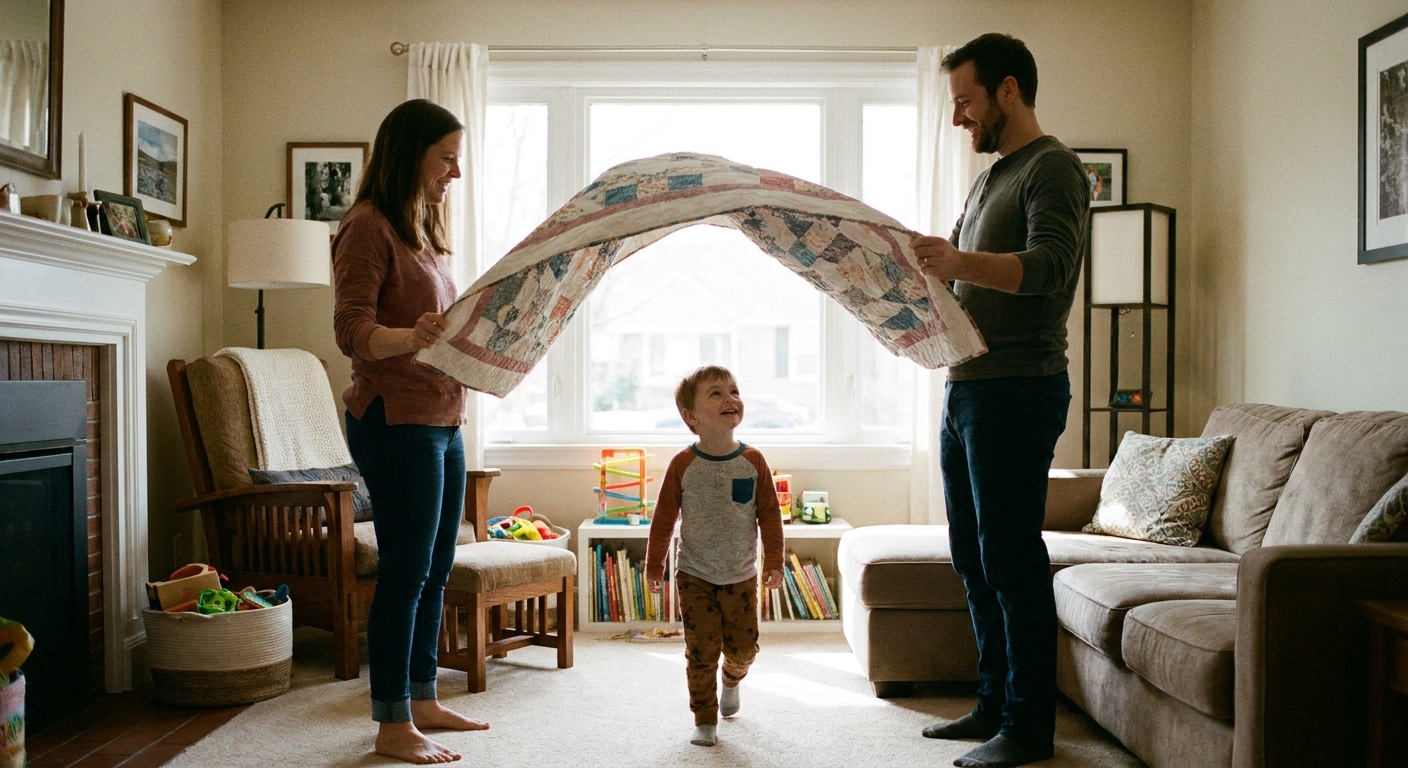
How we move: Two grownups (or older kids) make an arch. The rest walk underneath on the beat.
Little-kid friendly version: Keep the “bridge” high and wide and skip the dramatic “trap.” Make it about walking and ducking safely.
Turn rhymes into a 10-minute gross motor routine
If your day has a predictable “zoomies o’clock,” it helps to have a tiny plan. Here is one I use at home and in community center playgroups.
1 minute: Warm-up
- March around the room to “The Wheels on the Bus.”
- Add two big stretches: reach up, then touch down.
6 minutes: Move and repeat
- Round 1: “Head, Shoulders, Knees, and Toes” (slow, then faster).
- Round 2: “Teddy Bear, Teddy Bear” (pick 6 to 8 lines).
- Round 3: “If You’re Happy and You Know It” (stomp, jump, freeze).
3 minutes: Cool-down
- Slow “Ring Around the Rosie” with gentle steps.
- Finish with three deep breaths together and a long stretch.
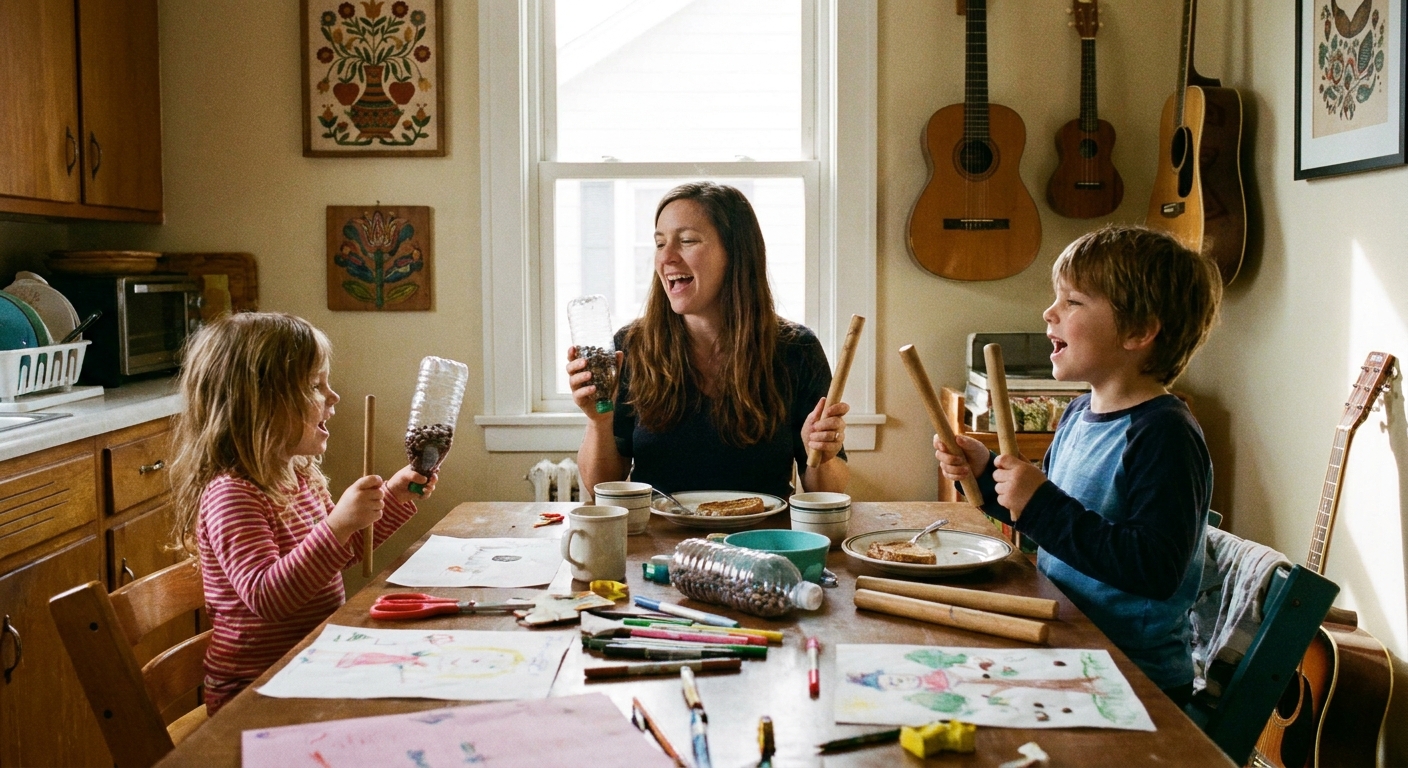
If your child loves props, homemade instruments can keep the beat without adding extra chaos. Our DIY shakers and rhythm sticks are perfect for stomping songs and marching rhymes.
Easy variations for different ages
For 1 to 2 years
- Choose rhymes with one main motion (stomp, march, bounce).
- Keep turns optional. Many toddlers get wobbly fast.
- Model first, then invite: “Your turn.”
For 3 to 4 years
- Add direction words: forward, backward, sideways.
- Add levels: reach high, crouch low.
- Try simple left and right in Hokey Pokey, but do not stress it.
For mixed ages
- Give older kids “coach” jobs: they pick the next verse or call the freeze.
- Let younger ones repeat a favorite line while big kids do the harder version.
For different abilities and sensory needs
- Offer a seated option (arm circles, claps, toe taps) if standing balance is tricky that day.
- Reduce turning and jumping if your child gets dysregulated, and lean on marching, pushing, or wall “high fives.”
- Use visual cues like a tape square to stand on, or show one move at a time.
Quick troubleshooting (because real life is real)
My child gets too wild with jumping
Switch to marching or stomping and add more “freeze” moments. I also love “Wheels on the Bus” for big motion that stays more organized.
My child refuses to do the motions
Try doing it with a stuffed animal first. Teddy does the moves, your child watches, then usually the body joins in when nobody is “making” it happen.
We have a small space
Choose in-place moves: toe touches, squats, marching, arm circles, reaching side to side. A painter’s-tape path down a hallway also works well for “march the line” games.
Someone always bonks into siblings
Give each child a “spot” like a towel square. Or put a line of painter’s tape on the floor and say, “Your feet stay on your tape while we sing.”
Why these rhymes help gross motor skills
When kids sing and move at the same time, they are practicing a bundle of skills in one happy package:
- Balance (standing on one foot, turning, stopping without toppling)
- Coordination (hands and feet doing different jobs)
- Motor planning (figuring out how to do a new action)
- Core strength (squats, reaches, controlled sits to the floor)
- Self-regulation (speeding up, slowing down, freezing on cue)
It is play, but it is also real practice that can help lay groundwork for things like climbing stairs, pedaling, catching a ball, and all the big-body confidence that comes next.
A few gentle notes for caregivers
You do not need a “good singing voice” to make this work. Kids mostly want your attention and your willingness to be a little ridiculous for two minutes. If that is a tender spot for you, I wrote Sing to Your Baby (Even If You Hate Your Voice) with you in mind.
And if you ever want to weave in calmer songs after a high-energy burst, our bedtime-friendly picks live at The Science of Lullabies.