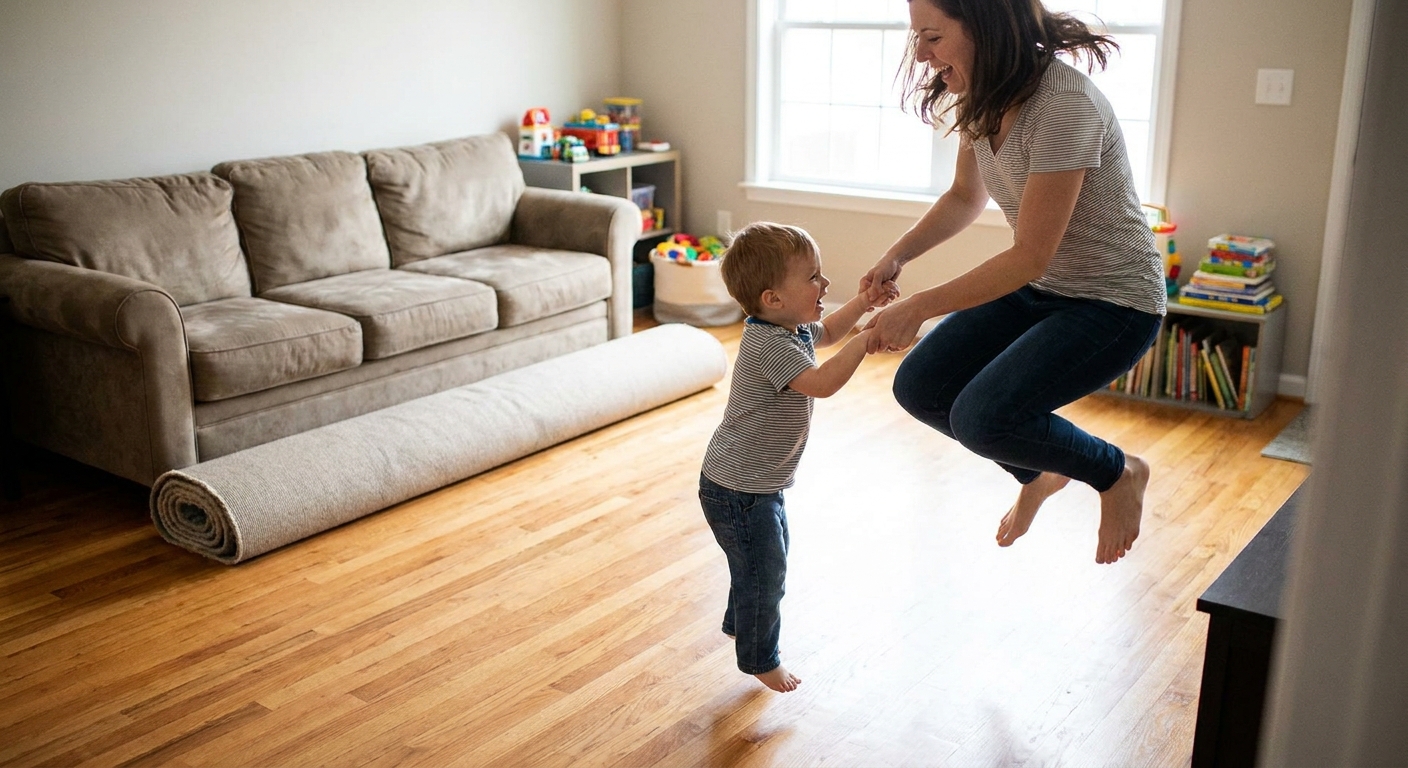

One rainy afternoon, I watched my youngest “read” a picture book by bouncing on the couch and narrating the whole thing like a sportscaster. I could have shushed the wiggles, but instead I grabbed a blanket for a “yoga mat” and said, “Let’s act it out.” Suddenly the story had a mountain to climb, a river to cross, and a brave hero to become. The book still got read, and those busy little legs finally had a job.
That is the heart of storytime yoga. We keep the literacy part, but we invite the whole body to join in. You do not need fancy poses or perfect form. You just need a tale, a small patch of floor, and permission to be delightfully dramatic.
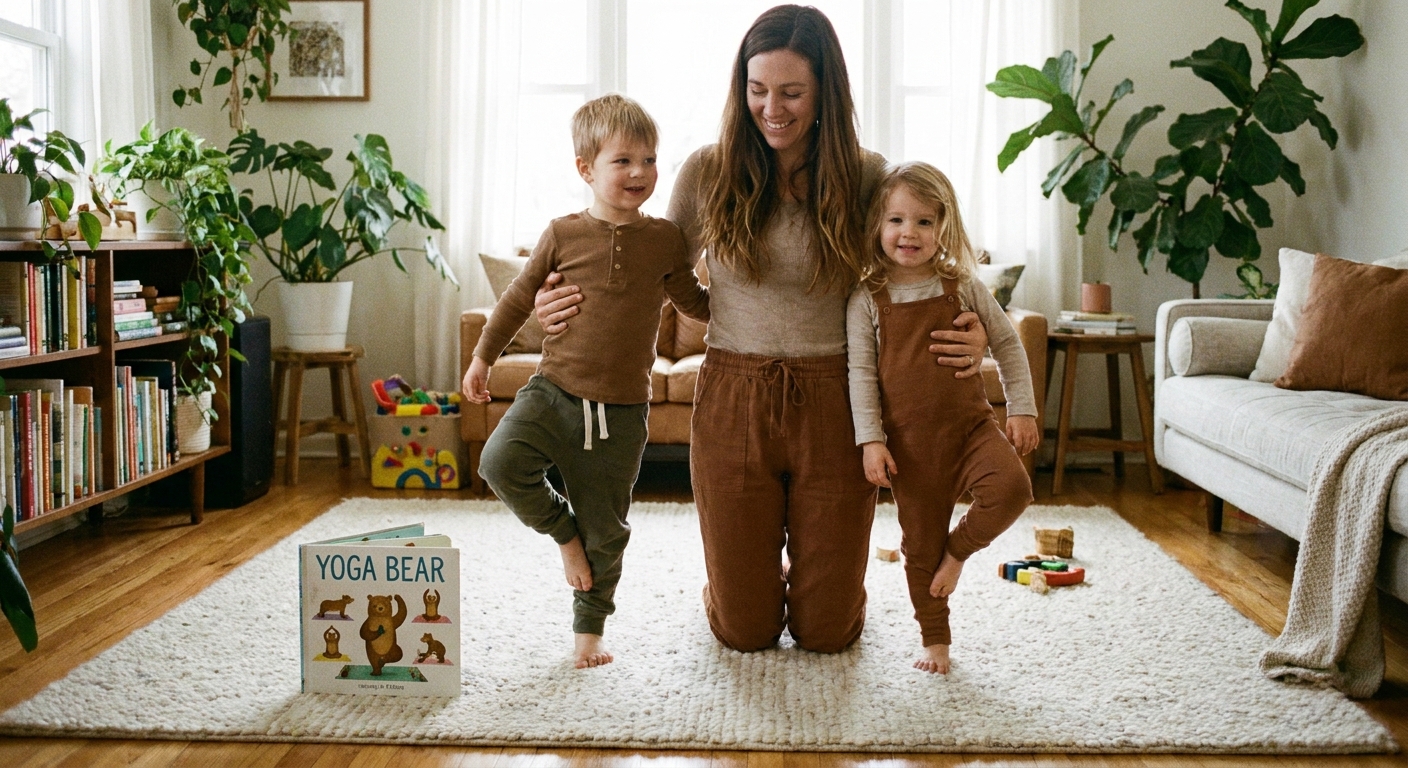
Why storytime yoga works so well
When kids pair movement with a story, a few wonderful things tend to happen at once:
- Better attention: Moving through the “action parts” can make listening easier than sitting perfectly still.
- Body awareness: Kids practice balance, crossing midline, and noticing where their arms and legs are in space.
- Language and comprehension: Acting out verbs like tiptoe, reach, curl, or roar helps those words stick.
- Emotional regulation: Big feelings show up in stories. Poses and breathing give kids a safe way to “try on” bravery, calm, or silliness.
If you already use songs during routines, this will feel familiar. It is the same “whole body storytelling” energy I love in action rhymes. If you want a quick warm-up before you start, you can borrow a few movement songs from 15 Classic Action Songs for Preschool Fine Motor Skills.
Before you start: a cozy setup that keeps it safe
What you need
- A picture book or a story you know by heart
- A clear space (even a hallway works)
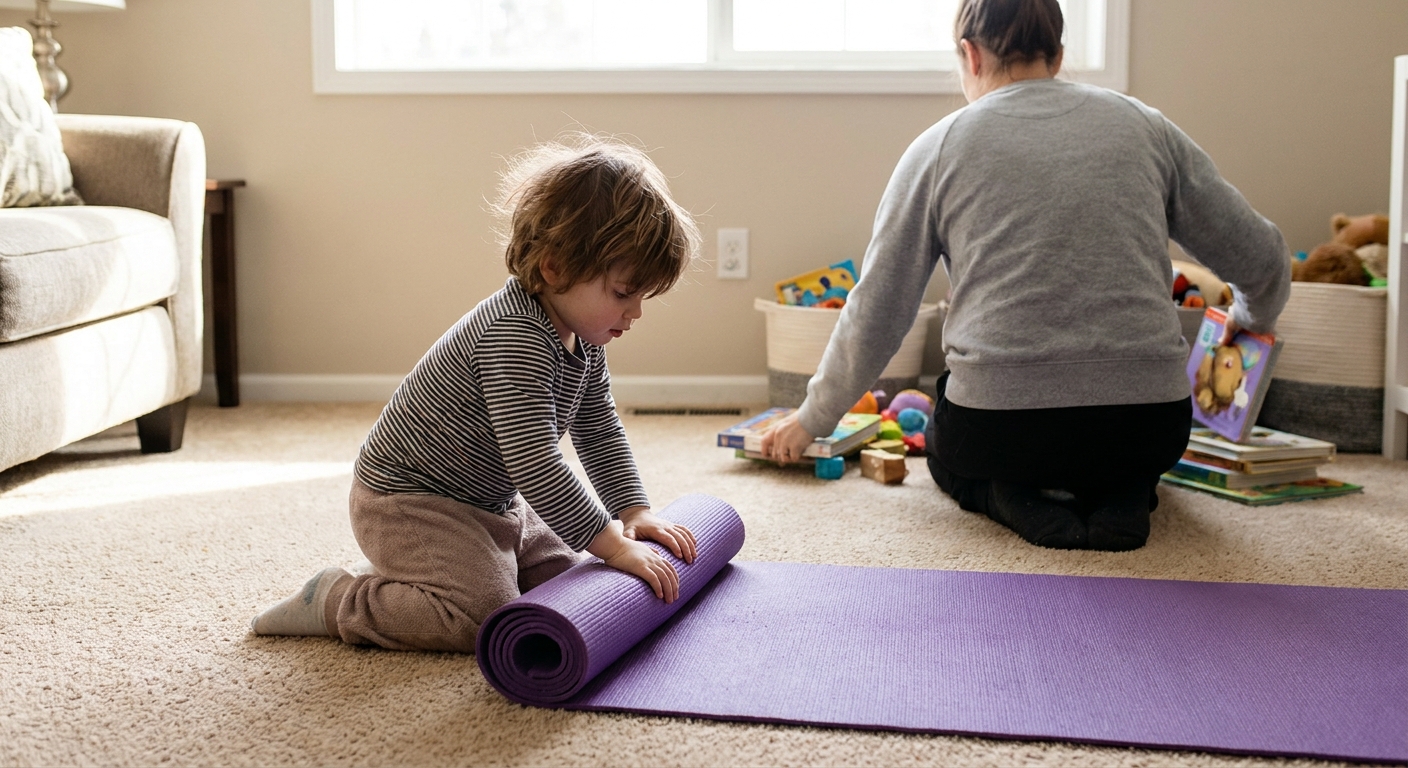
- Optional: a yoga mat, carpet square, or folded blanket
- Optional props: a scarf (river), pillow (mountain), stuffed animal (sidekick)
My three rules for kid yoga
- Soft knees, soft landings: We move slowly and keep knees a little bent for balance.
- No pose is a test: If a pose hurts, we change it or skip it. Period.
- Grown-ups model “good enough”: Wobbles are allowed. Giggles are expected.
Quick note: If your child has pain, dizziness, or a condition you are managing with a clinician, check in with them before trying new physical activities.
How to pair yoga with any children’s book
I like to read the story once straight through, then read it again with movement. On the movement round, you can do this simple pattern:
- Spot a moment: “Oh, the character is sneaking!”
- Pick a pose: “Let’s do Tiptoe Cat.”
- Hold for 2 breaths: In through the nose (or a quiet sniff), out through the mouth like fogging a window.
- Return to the page: “Okay, what happens next?”
For toddlers, I keep each pose to one breath. For older kids, we might hold longer and add details like “What does your face look like when you are the dragon?”
The 8 storytime yoga poses (with kid-friendly prompts)
These are beginner-friendly, flexible poses you can drop into almost any tale. I’m giving you story cues, simple steps, and easy modifications so everyone can join, including wiggly beginners.
1) Book Mountain (Mountain Pose)
Story moments: A hero gets ready. A journey begins. Someone feels brave.
- How to do it: Stand tall, feet under hips. Arms by sides or reach up like a “tall book on a shelf.”
- Kid prompt: “Freeze like a statue in the castle hallway.”
- Make it easier: Hands on hips. Stand near a wall for balance.
2) Listening Bunny (Easy Seat with Bunny Ears Breath)
Story moments: A character hears a sound. Someone gets a clue. Quiet forest scenes.
- How to do it: Sit cross-legged or kneel. Make “bunny ears” with two fingers near your head. Take two slow breaths.
- Kid prompt: “Can your bunny ears hear a mouse tiptoeing?”
- Make it easier: Sit on a pillow or couch cushion.
3) Cat Sneak (Tabletop to Cat Pose)
Story moments: Sneaking past a giant. Creeping into a cave. Exploring.
- How to do it: Hands and knees. Round your back like a Halloween cat. Then return to a flat back.
- Kid prompt: “Round up like you are sliding under a table.”
- Make it easier: Do it standing: hands on knees, gently round and unround.
4) Big Bear Stomp (Wide-Leg Forward Fold, bent knees)
Story moments: A big creature appears. Walking through snow or mud. A heavy giant steps.
- How to do it: Stand with feet wide. Bend knees a little. Tip forward and let arms dangle like bear paws.
- Kid prompt: “Stomp slowly, then freeze and sniff the air.”
- Make it easier: Hands on thighs instead of hanging down.
5) Tall Tree Lookout (Tree Pose)
Story moments: Looking for home. Spotting a ship. Watching for dragons.
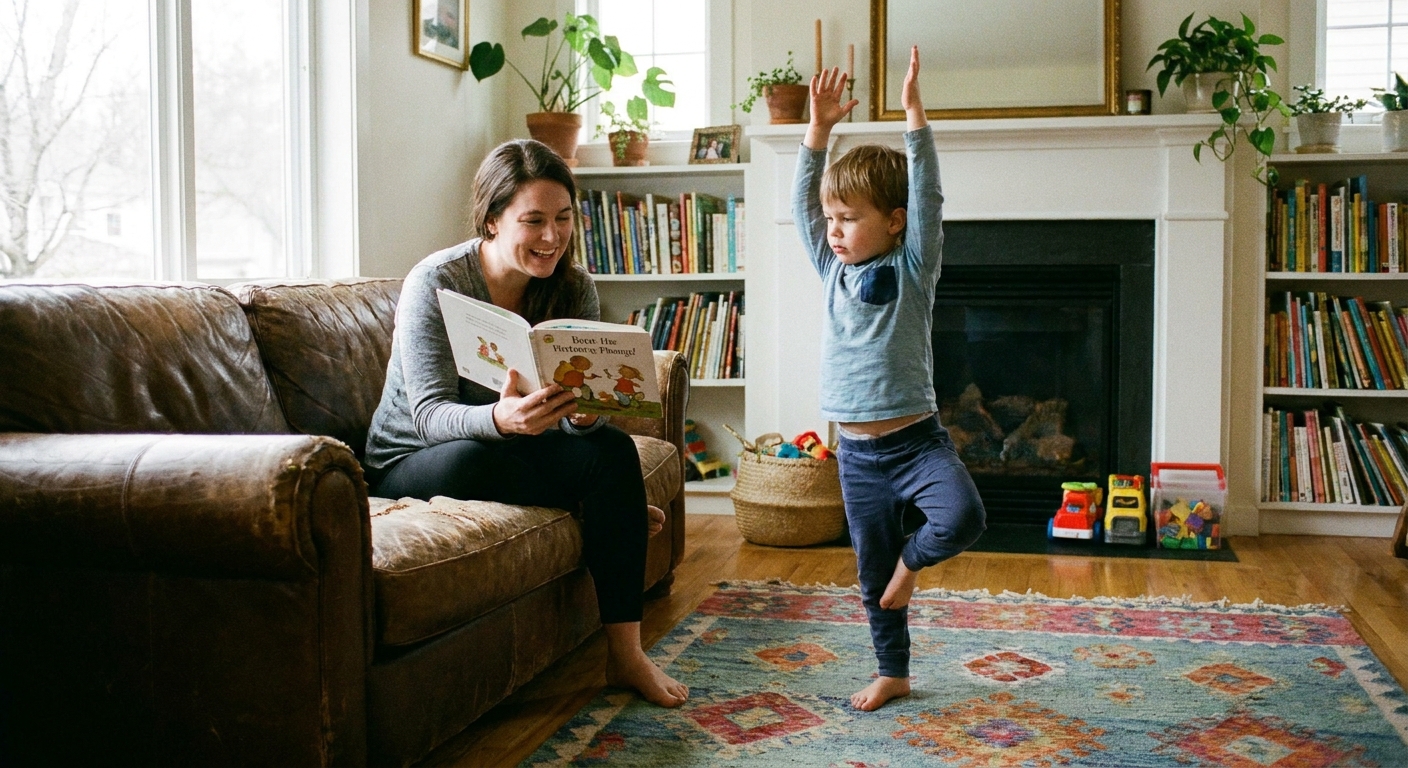
- How to do it: Stand tall. Put one foot to ankle or calf (not the knee). Hands together at chest or branches overhead.
- Kid prompt: “Your tree is the lookout tower. What do you see?”
- Make it easier: Keep toes on the floor like a kickstand. Or hold a wall.
6) Bridge Over the River (Bridge Pose)
Story moments: Crossing water. Helping friends get over something tricky. Building a bridge.
- How to do it: Lie on your back, knees bent, feet on the floor. Lift hips like a bridge. Arms by sides.
- Kid prompt: “Can your bridge hold three pretend footsteps?”
- Make it easier: Lift hips just a tiny bit, then rest.
7) Dragon Breath (Lion’s Breath or simple deep exhale)
Story moments: Dragons, roaring lions, blowing out candles, scary-but-funny scenes.
- How to do it: Sit or kneel. Big inhale. Exhale strongly with a “haaa” like a dragon puffing steam. (Tongue out is optional and usually hilarious.)
- Kid prompt: “Send your dragon breath across the room to push the clouds away.”
- Make it easier: Do a gentle “whooo” exhale like blowing a feather.
8) Cozy Shell (Child’s Pose)
Story moments: Hiding, resting, waiting, bedtime endings, “safe place” moments.
- How to do it: Kneel, sit back toward heels, fold forward and rest forehead on arms or the floor.
- Kid prompt: “Curl up like a turtle in its shell. You are safe and cozy.”
- Make it easier: Put a pillow under the chest or rest on the couch with head on folded arms.
Little writer tip from my messy craft table: Kids love naming poses after the story. “Bridge Pose” becomes “Troll Bridge,” “Rainbow Bridge,” or “Bridge to Grandma’s House.” Let them rename everything. Ownership is magic.
A simple 10 minute storytime yoga flow
When you want an easy plan, here is my go-to order. You can use it with almost any book.
- Book Mountain (2 breaths): “We are ready.”
- Listening Bunny (2 breaths): “We are paying attention.”
- Cat Sneak (2 rounds): “We explore.”
- Tall Tree Lookout (1 breath per side): “We search.”
- Big Bear Stomp (2 breaths): “We are strong.”
- Bridge Over the River (2 breaths): “We cross.”
- Dragon Breath (1 to 3 breaths): “We are brave.”
- Cozy Shell (3 breaths): “We rest.”
If your crew loves sound effects, sprinkle in a simple rhythm instrument. Homemade ones are perfect, and you can make them from recyclables. I keep ideas handy from DIY Shakers and Rhythm Sticks for Family Sing-Alongs.
Make it work for different ages
Toddlers (1 to 3)
- Do 3 to 4 poses total.
- Keep holds to one breath or one count to three.
- Use animals: cat, bear, bunny, turtle.
- Expect them to wander off and wander back. That counts.
Preschoolers (3 to 5)
- Let them choose the pose for each page.
- Add “freeze” moments: statue, mountain, tree.
- Give tiny jobs: “Show me how the character feels with your body.”
Big kids (6+)
- Assign roles: narrator, page-turner, pose-caller.
- Hold poses longer and add balance challenges.
- Try a “new ending” where they act out an alternate choice the character makes.
If your child says, “I don’t like yoga”
Totally fair. Some kids hear the word “yoga” and imagine they are being asked to be quiet and still forever.
- Rename it: Try “story moves,” “adventure poses,” or “acting it out.”
- Let them lead: Ask, “Show me how the monster walks.” Then copy them.
- Use a favorite theme: Space stories become Rocket Pose (Mountain with arms up), Moon Rock Pose (Cozy Shell), and Astronaut Lookout (Tree).
- Start with one pose: Just Listening Bunny during one page can be enough to build trust.
Frequently asked questions
Is storytime yoga safe for kids?
For most children, gentle poses with adult supervision are a safe way to move. Keep it slow, avoid forcing stretches, and skip anything that causes pain. When in doubt, choose simpler versions like seated breathing, hands-and-knees cat, or Cozy Shell.
Do I need to know yoga to do this?
Nope. If you can stand like a mountain and curl like a turtle, you are qualified. I learned almost everything I know from doing activities alongside my kids and adjusting as we went.
What kinds of books work best?
Books with clear actions are easiest: journeys, animal adventures, problem-solving tales, and anything with repeating patterns. But honestly, even quiet bedtime books work. You just choose quieter poses like Listening Bunny and Cozy Shell.
Can this help with bedtime?
Yes, especially if you keep the energy low. Try two or three poses only, then end in Cozy Shell with slow breaths. If lullabies are part of your nighttime routine, you might also like The Science of Lullabies: 7 Calming Bedtime Songs to Help Babies Sleep.
A sweet way to end
After the last page, I like to ask one tiny question while we rest: “What was your favorite part to act out?” Kids will often retell the whole plot right there on the floor, still in their Cozy Shell, still in the story.
That is the goal, really. Not perfect poses. Not perfect listening. Just a home where stories can be heard with the ears, remembered with the heart, and practiced with the whole wiggly body.