
One of my favorite family tricks for those wiggly in-between moments (waiting for dinner, sitting around a campfire, staring down a long car ride) is a game that needs exactly zero supplies. We call it the Round-Robin Story Game, and it’s as simple as it sounds: everyone builds one story together, one sentence at a time.
The magic isn’t in telling a perfect tale. It’s in watching your kids light up when their tiny idea becomes part of something bigger, sillier, and more memorable than anything one person would have come up with alone.
What it is
Round-robin storytelling is a cooperative game where each person contributes a small piece of a shared story, usually one sentence (or one short turn) at a time. The goal is to keep the story moving, include everyone, and enjoy the surprise twists.
If you’ve ever listened to kids tell you about their day and thought, “We started at school and somehow ended up with a dragon,” you already understand the vibe.
Basic rules
I like to explain the rules in under 20 seconds. If it takes longer, someone will wander off to inspect a napkin.
- We go in a circle. Everyone gets a turn, even if their turn is one tiny sentence.
- One sentence per turn. Short is your friend. Little kids can do a few words.
- Use “Yes, and...” energy. We build on what the last person said, instead of undoing it.
- No ending the story early. Nobody can say “The end” until the group agrees we’re ready.
- Kind twists only. Scary can be fun, but we skip anything that will make a sibling cry at bedtime.
My table rule: If you add a problem (storm, troll, missing cookie), your next turn has to add a helpful clue or a possible solution. It keeps the story from spiraling into nonstop doom.
How to start
The hardest part is the first line. After that, the story usually runs away on its own like a shopping cart with a mind of its own.
Pick one quick starter
- A character: “A curious raccoon named Ringo...”
- A place: “Deep under the kitchen sink...”
- A problem: “The moon disappeared right before bedtime...”
- A mystery object: “We found a tiny door behind the bookshelf...”
Use a starter sentence
Try one of these and then pass to the next person:
- “Right when we thought it was an ordinary day, we heard...”
- “On the very first page of the map, it said...”
- “In the middle of the backyard, there was a...”
- “Grandma opened her suitcase and out jumped...”
If your group needs extra support, set a theme: pirates, space, animals, fairy tale remix, or “everything happens at a grocery store.”
Themes help kids who freeze up when there are too many options.
Prompts I love
When the story starts to wobble or someone says, “I don’t know,” I toss in a prompt like a life preserver. You can ask it as a question, or you can make it their sentence.
Twist prompts
- “Something tiny becomes enormous. What is it?”
- “A friend shows up unexpectedly. Who is it?”
- “The plan almost works, but then...”
- “They discover a secret rule about this place. What rule?”
Cozy prompts
- “Someone makes a snack that solves a problem.”
- “They build a safe hideout using ordinary stuff.”
- “A lost creature needs help getting home.”
- “A kind stranger teaches them a new game.”
Giggle prompts
- “The hero has an absolutely ridiculous hat. Describe it.”
- “A dramatic animal makes a speech.”
- “Everything is normal until the soup starts...”
- “A villain is defeated by something silly, like bubbles.”
Variations by age
Toddlers and preschoolers
- Use “one phrase” turns: “Big truck!” “Purple cat!” “Splash!”
- Offer two choices: “Do we go to the jungle or the moon?”
- Repeat and expand: You can echo their idea and make it a sentence: “Yes. The purple cat zoomed to the moon.”
If you want a fun add-on for little hands, pair the game with props you can hold while you speak. I love simple puppets for this, and we have a bunch of ideas in 7 Creative Paper Bag Puppets for Singing and Reading.
Elementary kids
- Add a gentle challenge: Every sentence must include a color, a sound, or a feeling word.
- Try “two-sentence turns” for kids who have more to say, but keep the circle moving.
- Give someone the job of “recapper” who summarizes every five turns.
Teens and mixed ages
- Genre round: Everyone must keep it in one genre (mystery, sci-fi, comedy).
- Style round: Each person must start their sentence with “Suddenly,” “Unfortunately,” or “Meanwhile.”
- Director’s cut: One person can call “flashback” once per story, and the group has to explain it.
How to end well
Endings can be the trickiest part because kids want to add one more twist forever. When I feel the story starting to loop, I offer a simple landing pad and let the next few turns bring it home.
- The “home and snack” ending: Everyone gets safely home and eats something cozy.
- The “photo moment” ending: The characters pause for one last funny image (victory dance, silly hat, pancake crown) and we stop right there.
- The “promise” ending: Someone says, “We’ll come back tomorrow,” and we save the rest for another round.
Accessibility tricks
If a child is shy, tired, or just not feeling verbal, I keep them in the circle without putting them on the spot.
- Whisper turns: They whisper their sentence to you, and you say it for them.
- Point-and-pick turns: You offer two options out loud and they point.
- Gesture turns: They act it out (tiptoe, stomp, shiver), and someone else turns it into words.
Campfire mode
Campfires turn every story into a performance, which is wonderful, right up until it’s bedtime and you’ve accidentally invented “The Screaming Shadow of Pinecone Ridge.”
Here’s how I keep it cozy:
- Choose a not-too-scary setting: a traveling circus, a magical bakery, a forest ranger station.
- Use sound effects instead of jump scares: crackling leaves, owl hoots, a distant kazoo.
- End with a comfort turn: the characters return home, share food, or find a safe shelter.
If you want to layer in singing between story turns, it pairs beautifully with 10 Silly Campfire Songs for Kids.
Dinner table mode
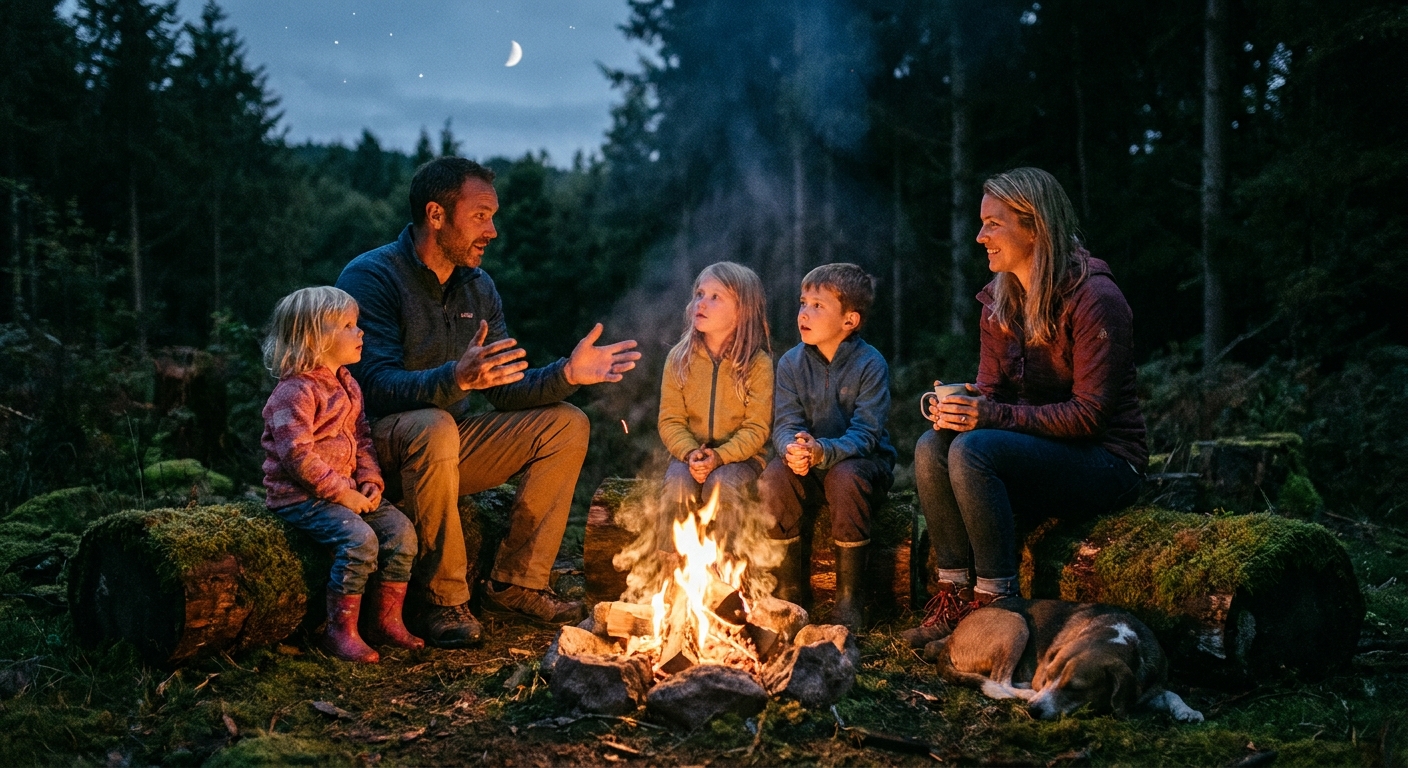
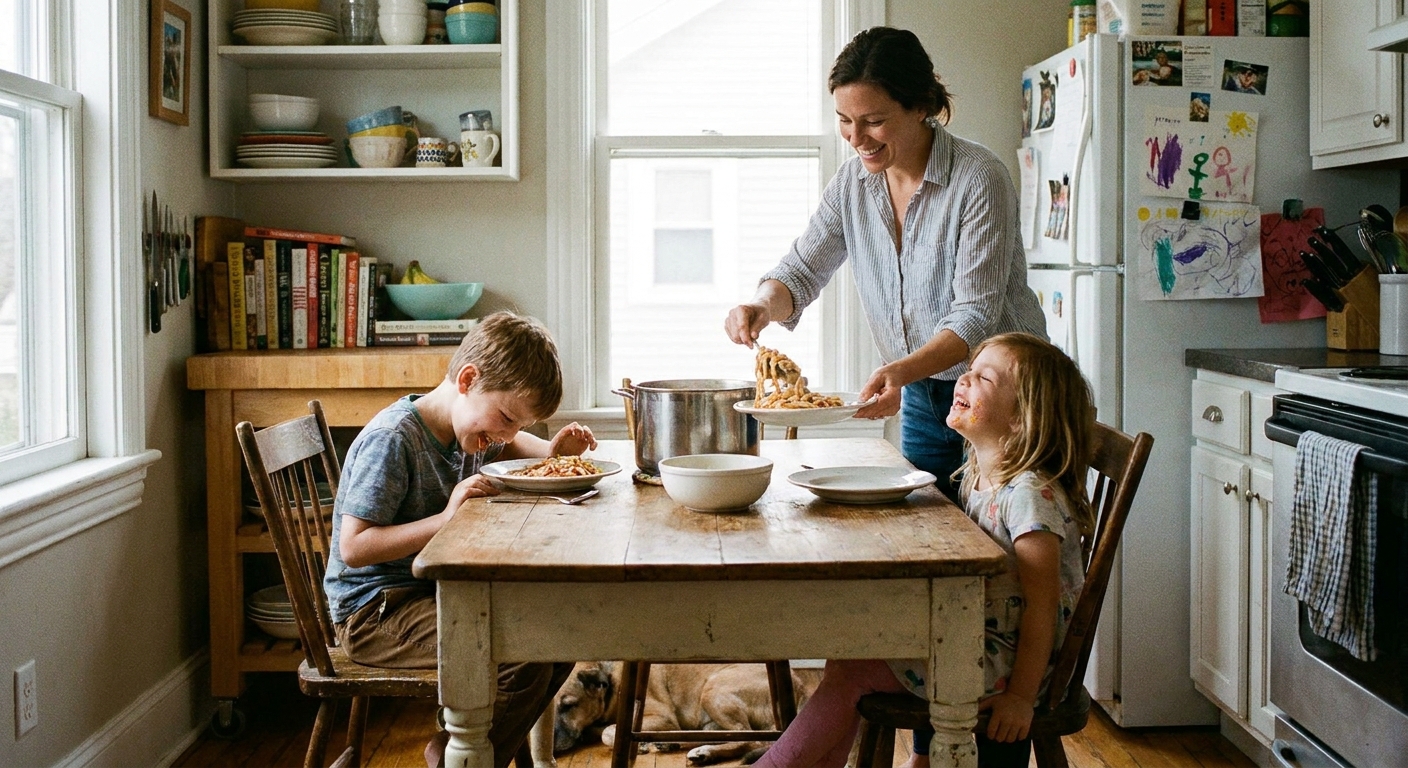
The dinner table version works best when it’s quick, predictable, and low pressure. I like to do a “three-round story,” where we go around the table three times and then wrap it up. Everyone knows the finish line exists, which helps.
Three-round dinner structure
- Round 1: Introduce the character and the problem.
- Round 2: Make the mess bigger, but keep it friendly.
- Round 3: Solve it and end on something sweet or funny.
If your family loves little routine songs to anchor transitions, you might also like 8 Transition Songs for Tidy-Up Time. I’ve used those same tiny cue songs to signal: “Okay, story time begins.”
Road trip mode
In the car, I swap “one sentence” for “one turn,” because road noise and car seats make long sentences hard to follow. A turn can be:
- One sentence
- One decision (left or right, cave or castle)
- One sound effect
- One new character
To keep siblings from battling over who goes next, use a simple order: oldest to youngest, then reverse. Or go by seat row.
Call-and-response songs also fit beautifully between story beats, especially when the plot needs a little reset. Here are favorites for that: 20 Call-and-Response Songs for Road Trips.
Common problems
“Potty humor takes over”
I consider this a phase and a gift. Give it a boundary, not a lecture.
- Try a one-silly-word limit: one potty word per story.
- Redirect with a job: “You’re in charge of sound effects.”
- Offer a fun substitute list: “goo,” “slime,” “stinky socks,” “burp bubble.”
“Someone keeps undoing the story”
This is where “Yes, and” saves the day. If a kid says, “Actually, that didn’t happen,” you can gently reframe:
- “Ooo, plot twist. In that case, what did happen instead?”
- “Let’s pretend both things are true. How could that work?”
“One child dominates”
Make the structure do the work.
- Use a strict one-sentence rule.
- Give the big talker a special role: “You do the recap every round.”
- Try a timer if you need it, but I often just tap the table and say, “And pass.”
“The story gets too scary”
Use a simple family safety phrase like “Back to cozy.” Then give an immediate comfort prompt:
- “Someone turns on a lantern.”
- “A friendly dog appears.”
- “They find a note that explains everything.”
If you have kids who are sensitive to certain themes, you may also appreciate my approach in How to Gently Rewrite Scary or Outdated Nursery Rhymes. The same gentle editing works for stories too.
Make it a tradition
Traditions stick when they’re small, repeatable, and attached to something you already do.
- Pick your moment: Friday dinner, Sunday breakfast, first night of a camping trip, or the walk to the bus stop.
- Name it: “Table Tale,” “Campfire Circle,” “Story Stew.” Kids love a name.
- Keep it short: End while everyone still wants more.
- Let kids lead: Once they understand the rhythm, your job becomes enthusiastic audience.
If your family starts collecting favorite characters or recurring settings, you might enjoy turning them into a keepsake with Make Your Own Family Songbook. I’ve seen kids absolutely glow when their made-up world feels real enough to save.
Starter stories
Here are three openings that tend to work even when everyone’s tired and hungry. Say one line and pass it along.
1) The Tiny Door
“When we moved the cereal boxes, we found a tiny door in the pantry, and it was warm on the other side.”
2) The Borrowed Shadow
“This morning, my shadow didn’t match my feet, and it winked at me from the sidewalk.”
3) The Lost Recipe
“Grandpa’s famous pancake recipe disappeared, and the only clue was a sprinkle trail leading to the backyard.”
FAQ
How long should a story last?
In our house, 5 to 10 minutes is plenty for little kids. With older kids, we can easily stretch it to 10 to 20 minutes if everyone’s into it. I try to stop while it’s still fun, not when it’s falling apart.
What if my child refuses to talk?
Let them pass without pressure, and offer a non-speaking job: sound effects, choosing the next setting, or being the official recapper. Many kids join in once they feel safe.
Can we play with two people?
Absolutely. Two-person round-robin stories are wonderful at bedtime. You can also add a stuffed animal who “takes a turn” to slow it down and invite silliness.