
Whenever my house gets that wiggly, rainy-day energy, I grab a stack of plain brown lunch bags and declare, “Tonight, we are putting on a show.” It is amazing how fast a living room turns into a tiny theater when a puppet starts “singing” back to your child.
These seven paper bag puppet characters are simple enough for preschoolers to help with, but flexible enough for big kids to add their own flair. Each one includes a quick build, a sing-along idea, and an easy reading prompt so you can use the same puppet for storytime and a musical play.
Before you start: the puppet basics
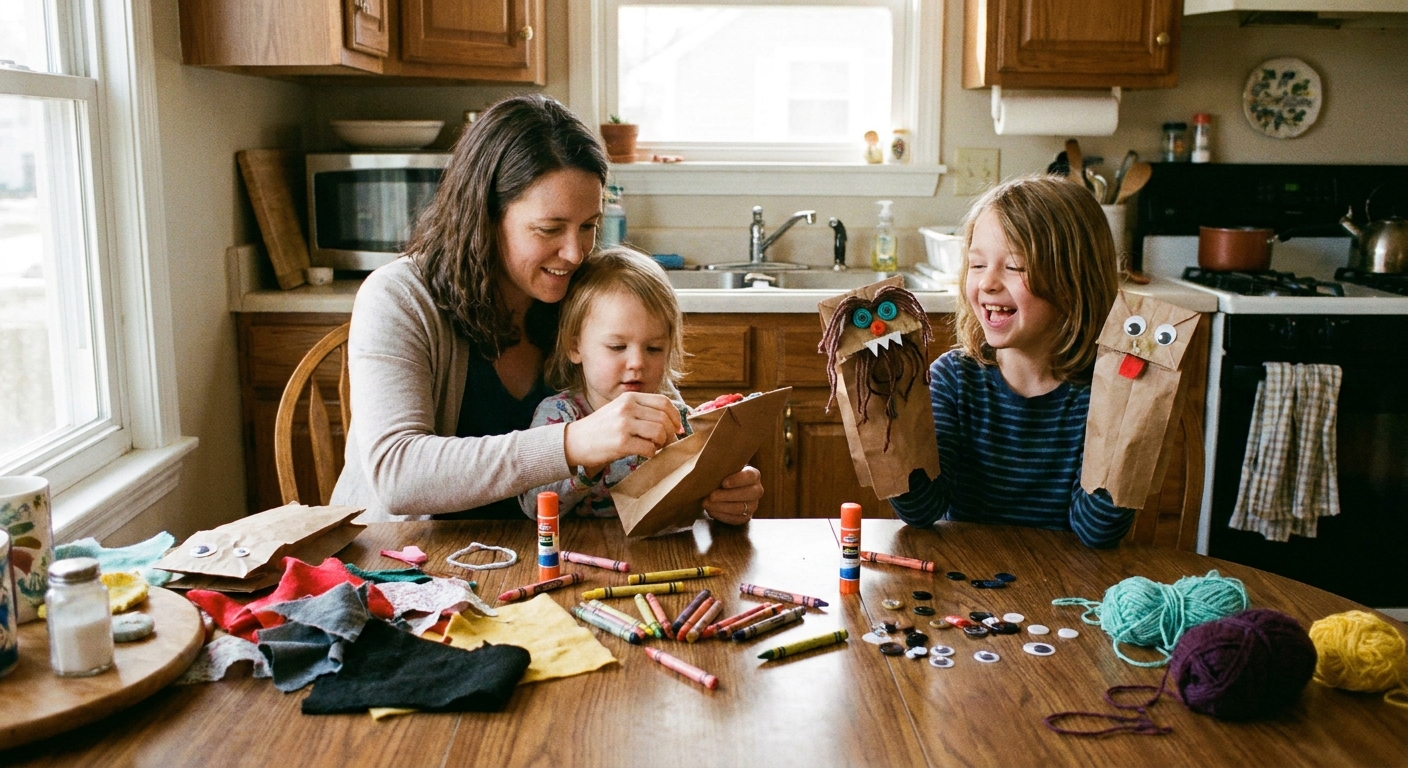
Materials I keep in a shoebox
- Standard brown paper lunch bags
- Glue stick (my favorite for quick, less-mess assembly)
- School glue (for yarn, buttons, thicker bits)
- Child-safe scissors
- Crayons or washable markers
- Construction paper scraps
- Yarn, ribbon, fabric scraps, or tissue paper
- Optional: googly eyes, stickers, tape
Quick safety note: Small add-ons like buttons and googly eyes can be a choking hazard for kids under 3. Save them for older kids, or use drawn-on details and supervise closely.
How the bag becomes a puppet
Lay the bag flat with the bottom flap facing up. It looks like a rectangle “lid” on one side of the bag, and that rectangle becomes the puppet’s mouth. Decorate the flap as the lower face or muzzle, and decorate the area above it as the upper face. When you slide your hand inside, your fingers lift the flap to make the puppet “talk” and “sing.”
My two favorite durability tricks
- Tape the inside corners of the mouth flap if your puppet will be used for lots of “encores.”
- Use a glue stick for paper-on-paper and save liquid glue for yarn, buttons, and anything thick.
Dry time that saves sanity: If you use school glue, give your puppet about 10 to 20 minutes to set before showtime (or keep a “practice puppet” going while the star dries).
1) The Big-Mouth Crocodile
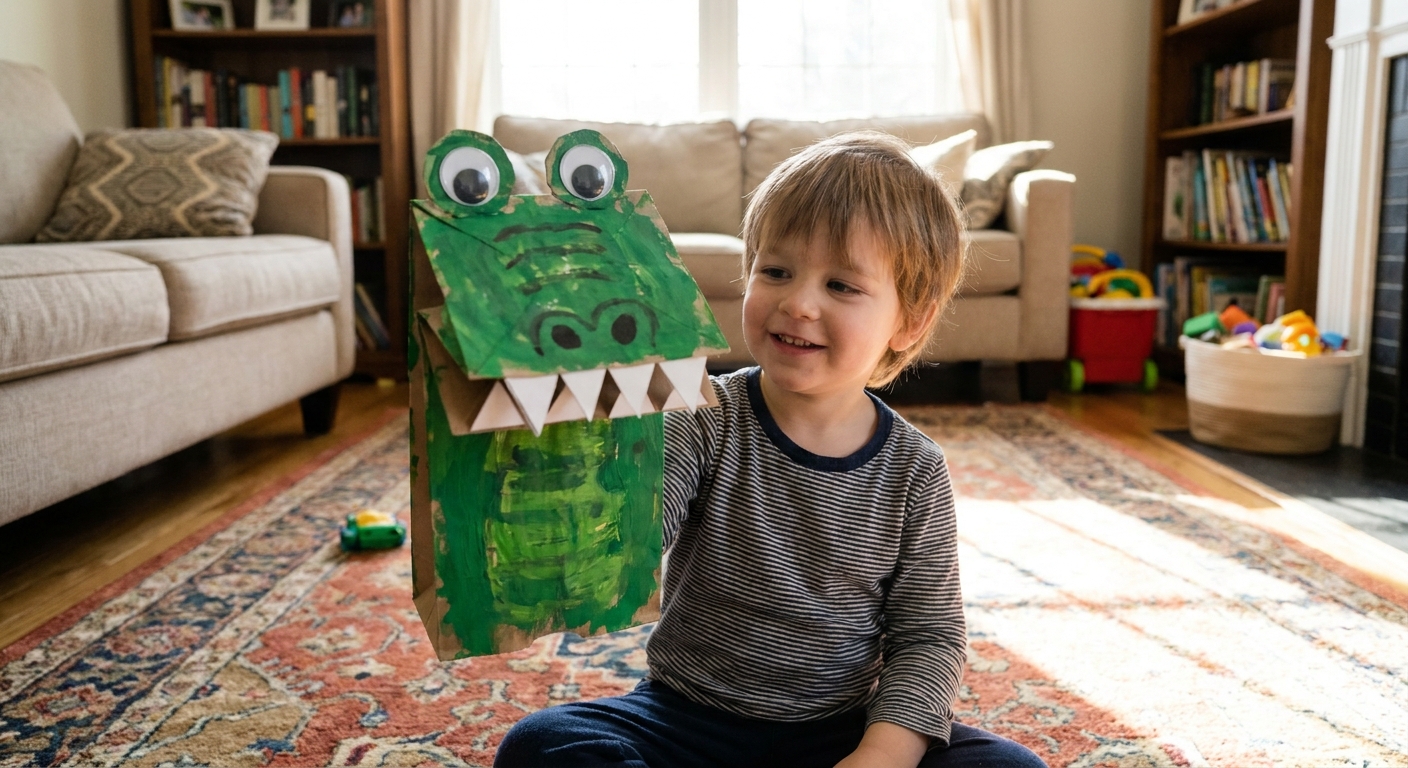
This one is a guaranteed hit for call-and-response songs because the mouth movement is so dramatic. If your kid loves being loud, make a crocodile.
Make it
- Color the whole bag green or cover it with green paper.
- Cut a long oval snout and glue it on the top section of the bag.
- Add teeth: small white triangles along the edge of the mouth flap and the edge above it.
- Add two bumpy “scale” strips (zigzags or bumps) along the sides.
Sing with it
Try a simple chant: “Chomp, chomp, crocodile, can you sing for us a while?” Have your child answer with a silly sound or a line from a familiar song.
Read with it
Pick a story with repeating phrases and let the crocodile “say” the repeated line. Pause and whisper, “Wait, is the crocodile going to read the next part?”
2) The Hoot-and-Hum Owl
An owl puppet is perfect for quieter moments when you want the play to feel cozy, like a bedtime story that accidentally became a musical.
Make it
- Cover the bag with brown or gray paper, or color it in.
- Cut two large circles for eyes and add smaller circles for pupils.
- Add a small triangle beak right above the mouth flap.
- Glue on “feathers” using layered scallops of paper or tissue.
Sing with it
Make the owl the “conductor.” The owl can hoot once for quiet singing, twice for loud singing, and three times for super-silly singing.
Read with it
Use the owl to ask prediction questions: “Hoo thinks the bear will go inside the cave?” Your child can answer, and the owl can repeat it back in a funny voice.
3) The Dinosaur With a Song Stomp
My kids have never met a dinosaur they did not want to give a theme song. This one pairs beautifully with action songs and marching rhythms.
Make it
- Color or cover the bag in any dinosaur color.
- Add a row of triangles along the top edge of the bag (the “back ridge”) for spikes or plates.
- Cut two short arms and glue them to the sides.
- Add a big eye and a nostril dot on the top section.
- Optional: glue a paper tail on the back of the bag so it sticks out behind.
Sing with it
Do a “stomp and stop” song. Every time you sing the word “stomp,” the dinosaur opens and closes its mouth. Every time you sing “freeze,” everyone holds still.
Read with it
After each page, have the dinosaur announce the setting: “This story is happening in the forest!” It is a small trick that helps little listeners track what is going on.
If you want more movement-friendly ideas, pair this puppet with a few favorites from 15 Classic Action Songs for Preschool Fine Motor Skills.
4) The Shy Skunk (With a Friendly Stripe)
A skunk puppet is a sweet way to practice social scripts: greetings, apologies, asking to play. Also, the stripe is delightfully easy to make.
Make it
- Color the bag black (or cover with black paper).
- Cut one wide white stripe that runs from the top down to the mouth flap.
- Add small round ears and a tiny nose.
- Optional: glue a fluffy tail shape to the back.
Sing with it
Use the tune of a familiar simple song and swap in polite phrases: “Hello, hello, hello to you.” Let the skunk “practice” saying it.
Read with it
Have the skunk act out feelings words from the story. If a character is worried, the skunk can hide. If a character is brave, the skunk can pop up and “announce” it.
5) The Storybook Dragon
This is the puppet I make when we want a bigger plot. Dragons naturally demand a quest, a treasure, and at least one dramatic musical number.
Make it
- Cover the bag in green, red, or purple.
- Add two horns on top and two wings on the sides.
- Cut a flame shape (red, orange, yellow layers) and glue it inside the mouth flap so it peeks out when the dragon “talks.”
- Add scales using small overlapping paper half-circles.
Sing with it
Try a “brave, brave, brave” chorus. Each time you sing “brave,” the dragon opens its mouth and the flame shows.
Read with it
Make the dragon the “word detective.” When you hit a fun word, like sparkle or stomp, the dragon repeats it and your child copies it.
If your family likes turning stories into scenes, you will also love Make a Paper Song Scene for quick backdrops.
6) The Silly Chef (Great for Food Songs)
A chef puppet is my secret weapon for picky-eater humor. The puppet can be picky, brave, or absurdly dramatic about broccoli, and it keeps the mood light.
Make it
- Draw a big smiling face and rosy cheeks.
- Make a tall chef hat from white paper: a rectangle band plus a puffy top shape.
- Add a simple paper apron shape on the front of the bag (a rectangle or trapezoid works well).
- Optional: glue a yarn mustache or paper bow tie.
Sing with it
Do a “stir, stir, stir” song. The chef can “taste” the soup by tapping the mouth flap gently open and closed.
Read with it
Use the chef to retell the story in three sentences at the end. You say the first sentence, your child says the second, and the chef puppet dramatically delivers the final sentence.
For more food-themed singalongs to pair with this puppet, peek at 9 Food-Themed Nursery Rhymes for Picky Eaters.
7) The Bright-Eyed Robot (Perfect for Sound Effects)
Robots are made for rhythm. Even if you do not feel “musical,” a robot voice gives you instant confidence.
Make it
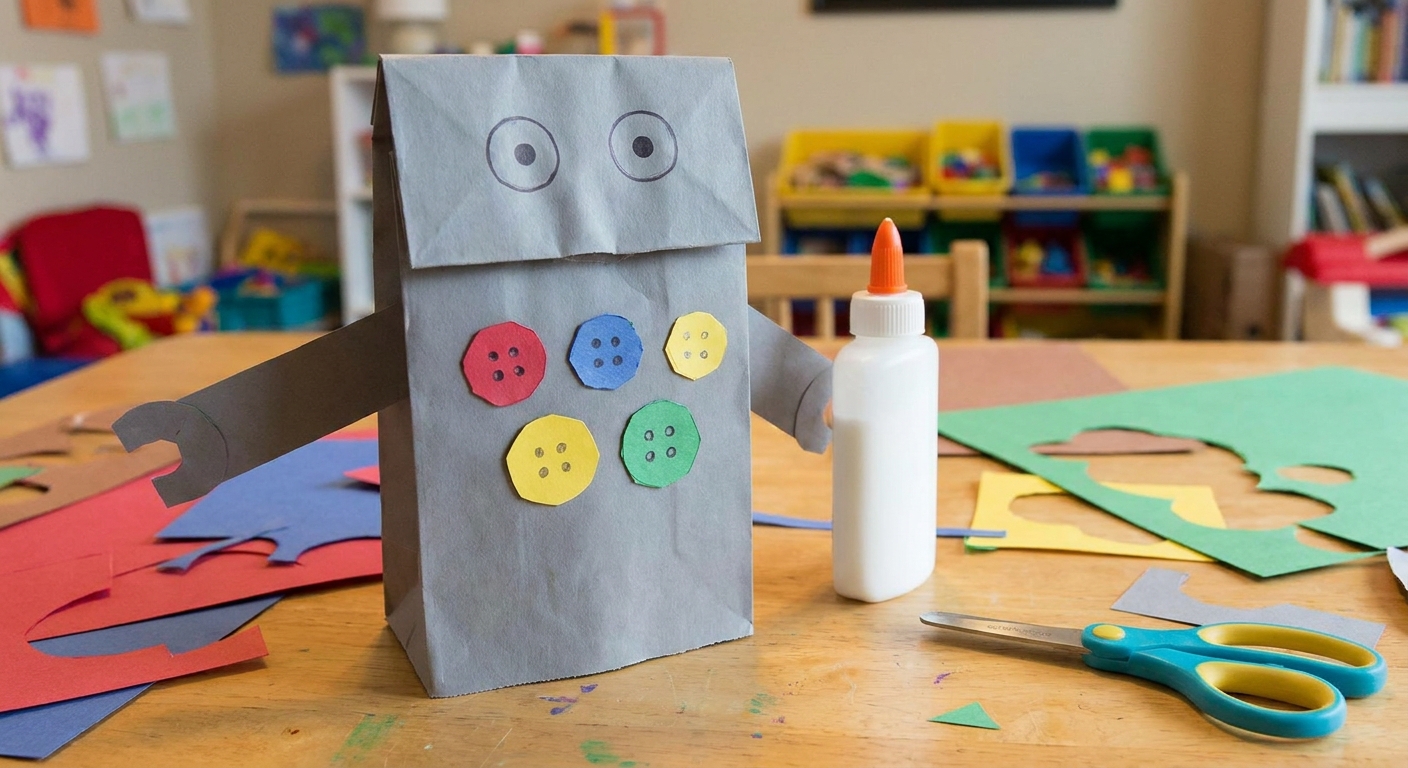
- Cover the bag with gray paper or color it silver.
- Add square or rectangle “buttons” on the front using bright scraps.
- Cut a rectangle mouth plate and glue it on the mouth flap.
- Add two paper antennae on top.
Sing with it
Turn any familiar song into “robot mode” by clapping a steady beat and speaking the lyrics in a rhythmic robot voice. Let your child decide when the robot switches back to regular singing.
Read with it
Have the robot read only the punctuation for one page (or a short paragraph). Every time you hit an exclamation point, the robot says “BEEP!” Every question mark gets a “BOOP?”
Turn puppets into a living room musical
A simple show plan that works
- Pick one song. Keep it short and familiar.
- Pick one book. Short picture books work beautifully.
- Assign one job per kid. Puppeteer, singer, page-turner, stage helper.
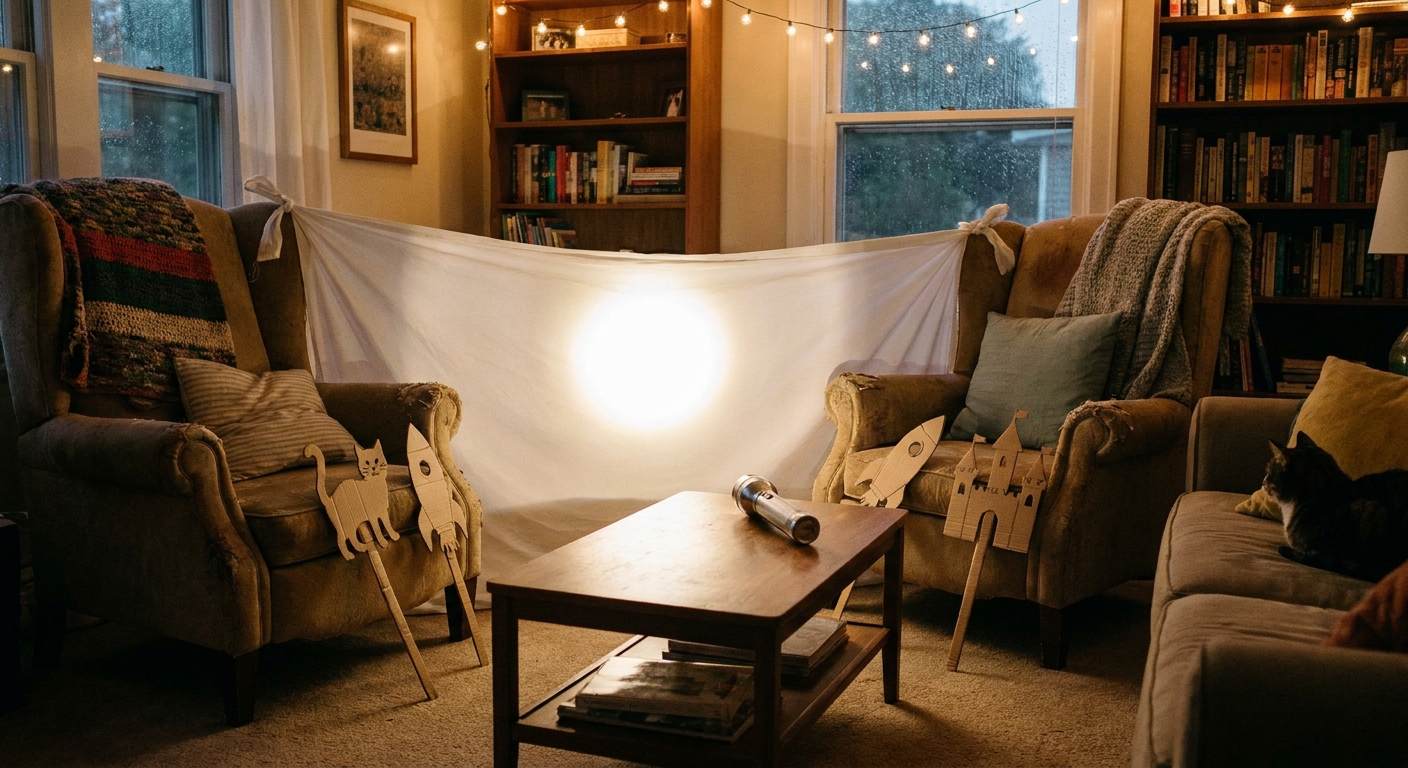
- Use a couch or coffee table as the stage. A sheet draped over two chairs is instant puppet theater.
- End with a bow. Everyone loves applause, even if it is just Mom clapping while holding a baby.
Easy prop add-ons from recyclables
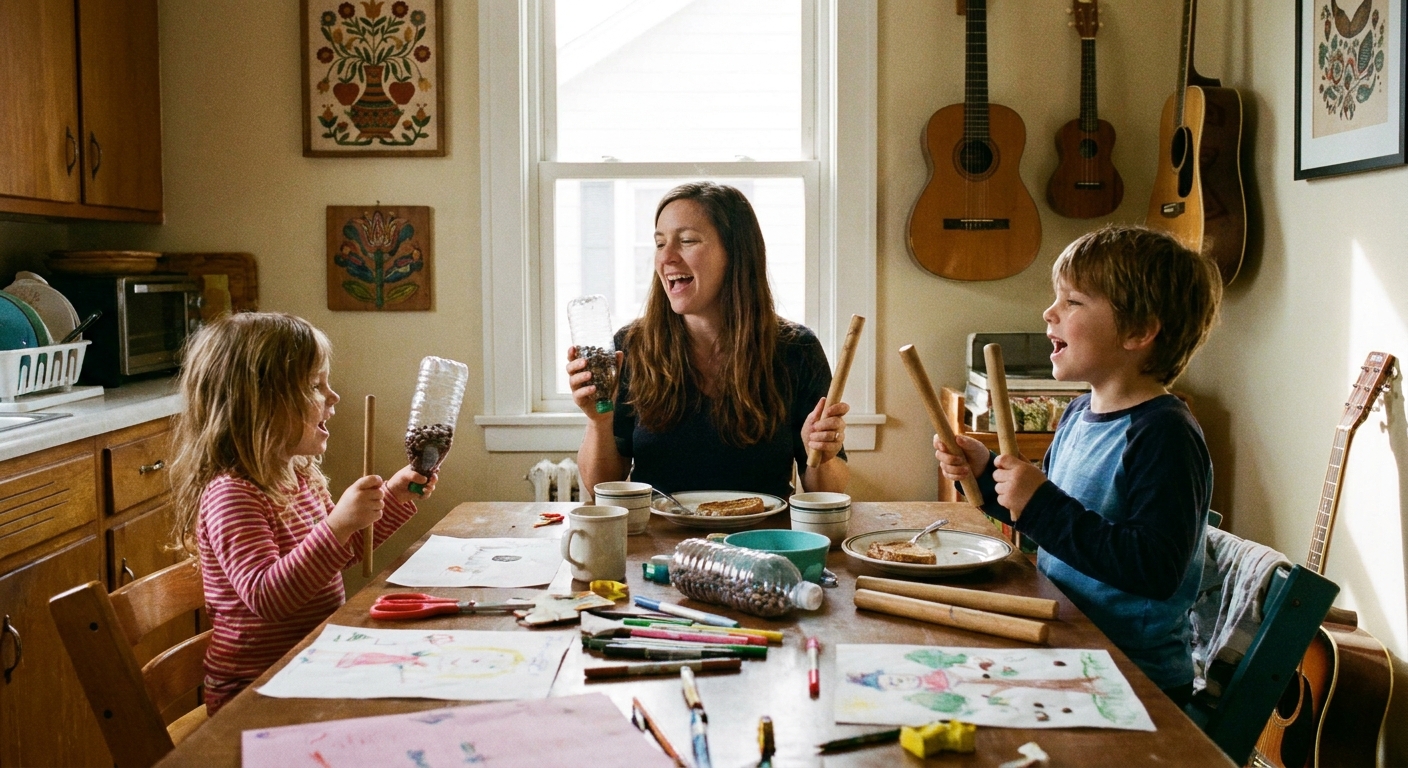
If your crew gets hooked, you can add quick instruments and scenery without complicating the craft table. I often pair puppet shows with homemade instruments from DIY Shakers and Rhythm Sticks for Family Sing-Alongs.
One small cleanup trick that helps in real life: I put a sheet of scrap paper or an old cereal box under the glue zone. When we are done, I fold it up and shake the bits into the trash.
Paper bag puppet tips by age
Toddlers (with close supervision)
- Let them color the bag and stick on large shapes.
- Skip small add-ons like buttons and googly eyes.
- Focus on singing and simple back-and-forth play.
Preschoolers
- They can cut simple shapes with help and choose character features.
- Invite them to name the puppet and decide its “catchphrase.”
Big kids
- Encourage props, a second puppet, or a tiny script.
- Let them direct: who sings, who speaks, when the puppet “dances.”
Quick troubleshooting
The mouth will not open well
Slide your hand deeper into the bag and pinch the bottom edge of the mouth flap with your fingers. If the flap is stuck, gently loosen it and tape the inside corners.
Pieces keep popping off
Paper-on-paper does best with a glue stick. Yarn and thicker pieces do better with school glue and a full dry time. If you need a fast fix, a small loop of tape can save the day.
My child only wants to crumple the puppet
Totally normal. Make two: one “performer” puppet and one “practice” puppet. The crumpled one becomes a sleeping character. The show goes on.
How I store them so they last
After the show, I stand the puppets upright in a box or a grocery bag so the mouths do not get smashed. If we made a whole cast, I write the character name on the bottom so the right puppet shows up for its big moment.
Once you have a few puppets in your house, you will start spotting “showtime moments” everywhere, right before dinner, after bath, during the long stretch before bedtime. The best part is that you do not need a script. You just need one puppet brave enough to sing first.