
The first time I tried a shadow puppet show in our living room, I was aiming for “sweet little bedtime moment” and accidentally created “standing-room-only theater,” complete with toddlers crawling under the sheet and a big kid arguing over who got to be the cow. It was chaotic, cozy, and honestly? Pure magic.
The good news is you do not need fancy puppets or special lights. With a flashlight, a sheet, and a bit of cardboard, you can act out nursery rhymes in a way that feels like an old-fashioned storybook come to life.
Why shadow puppets work for rhymes
Nursery rhymes are already built for repetition, rhythm, and tiny story arcs. Shadow play adds just enough drama to keep kids focused without making the setup complicated.
- Gentle for bedtime: Dim lights, soft voices, and slow movements signal “wind down.”
- Great for all ages: Babies watch the shapes, toddlers shout the rhymes, older kids run the puppets.
- Low pressure: Shadows hide wiggly hands and imperfect cuts. Everything looks cooler in silhouette.
If your family enjoys adding movement to songs, you might also like our classic action songs for preschoolers, which use the same idea of learning through playful motion.
What you need
Here is my “raid the recycling bin” supply list. Use what you have.
For the screen
- A light-colored sheet, pillowcase, or thin tablecloth
- Two chairs, a doorway, or a broomstick balanced between chairs
- Clothespins, binder clips, or hair clips to keep fabric taut
For the light
- A flashlight or headlamp (phone flashlight works in a pinch)
- Optional: a small box or stack of books to prop the light steady
For puppets
- Cereal box cardboard, shipping box cardboard, or cardstock
- Scissors (or a craft knife used by an adult only)
- Tape
- Popsicle sticks, paper straws, or unsharpened pencils for handles
- Optional: a hole punch and a brad fastener for a moving joint
Want to add sound effects? Homemade instruments are perfect for this. Our DIY shakers and rhythm sticks are easy to make and make the “clop clop” and “tap tap” moments extra fun.
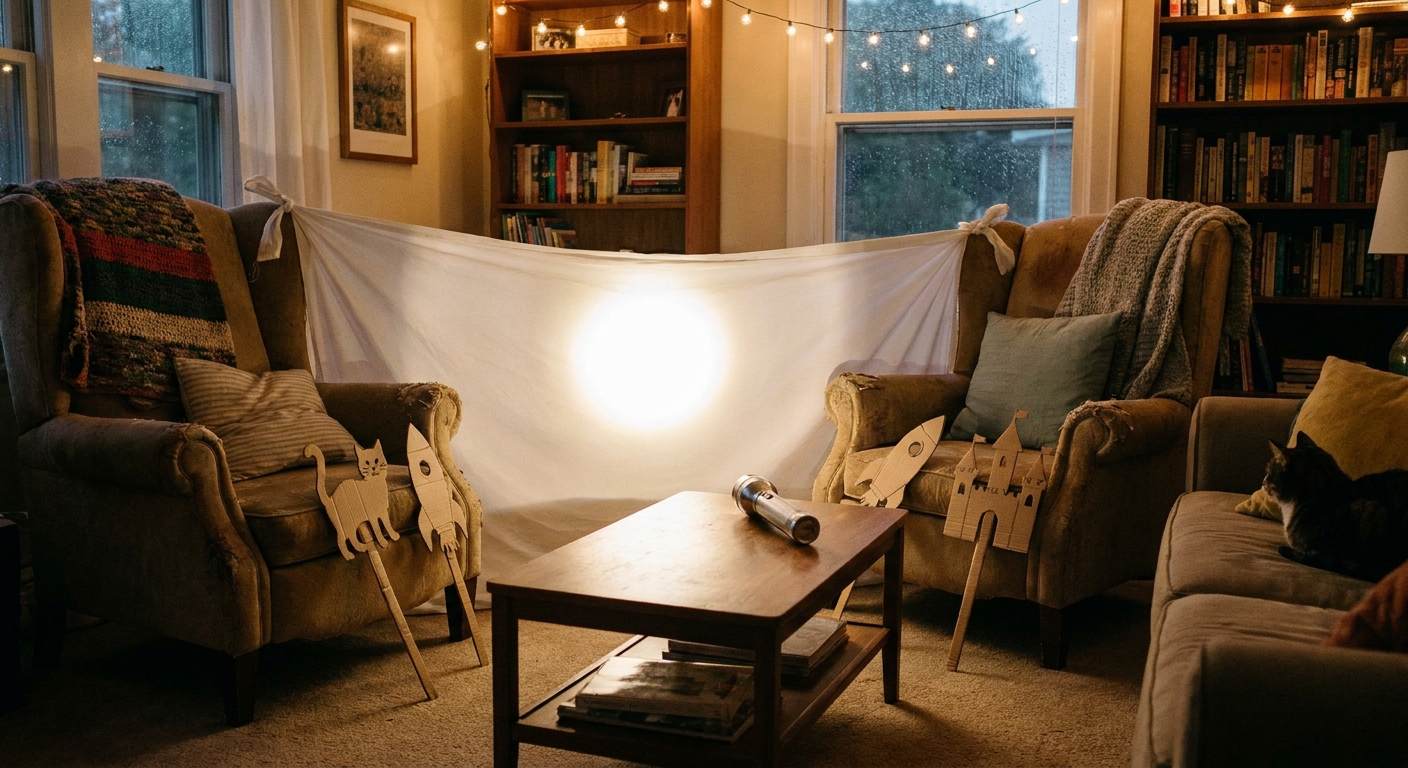
Set up your flashlight theater
You are building three zones: audience, screen, and backstage. The spacing matters more than perfection.
Step 1: Hang your screen
- Drape the sheet over two chairs or clip it in a doorway.
- Pull it taut so shadows look crisp. Wrinkles blur your puppet edges.
- Keep the bottom edge a few inches above the floor if you have little crawlers who will try to escape under it.
Step 2: Place the light
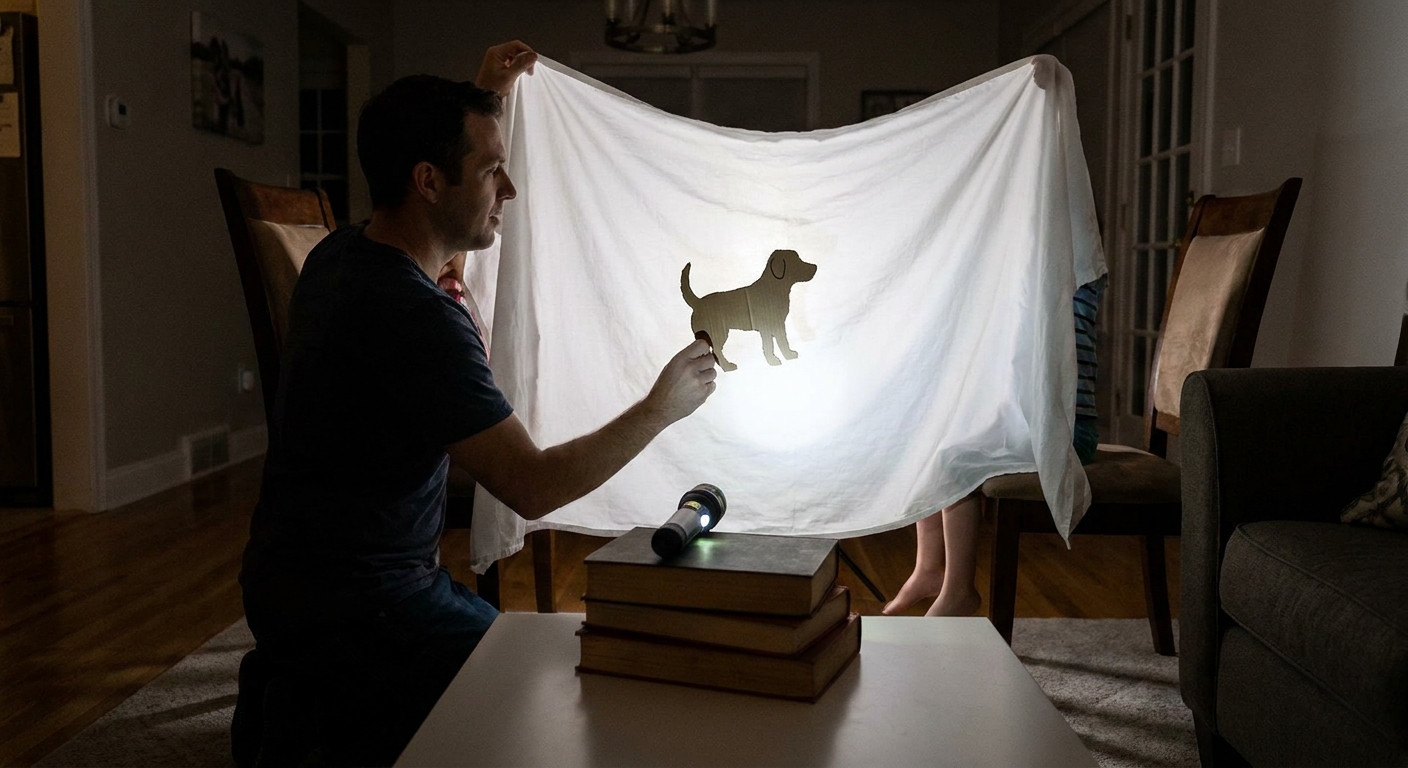
- Put the flashlight behind the screen, aimed at the center.
- Start a few feet from the sheet, then adjust. Brightness varies a lot by flashlight, especially phone lights.
- Closer makes a smaller, brighter circle. Farther makes a bigger, dimmer stage.
- Prop it on books or a box so it does not roll.
Quick sanity saver: Once the light is stable, I usually leave it alone and do most of the “zooming” by moving the puppet closer to the sheet or closer to the light.
Step 3: Create backstage space
- Leave enough room behind the sheet for the puppeteer to sit or kneel.
- Keep scissors, tape, and extra puppets in a little “backstage basket.”
One more tip that has saved me from a lot of backstage wandering: point the flashlight away from where kids will be standing, and remind helpers not to look into the beam.
Cut easy silhouettes
Now for the fun part. If you can cut a cloud, a triangle, and a lopsided duck, you are qualified.
My quick pattern trick
- Draw big shapes. Bold outlines read better as shadows than tiny details.
- Cut the outside first. Get your main silhouette before fussing with ears and tails.
- Tape on a handle. Tape a stick to the back, down low. Reinforce with a second piece of tape like an X.
- Test at the screen. Hold the puppet 1 to 3 inches from the sheet for a crisp shadow.
Shadow secret: The closer your puppet is to the light, the bigger and fuzzier the shadow becomes. The closer it is to the sheet, the smaller and sharper it becomes. Kids love experimenting with this once they notice it.
Simple puppet ideas
- Moon, stars, and a little bed
- Cat, cow, dog, and a dish (for “Hey Diddle Diddle”)
- Spider and water spout
- Humpty Dumpty egg shape (a big oval works)
- Little lamb
- Crown and candle (for “Jack Be Nimble”)
- Mouse, clock, and a big “1” (for “Hickory Dickory Dock”)
Optional: a moving arm
For something like “The Itsy Bitsy Spider,” add a bendy leg or arm:
- Cut the spider body and one long leg as separate pieces.
- Punch a hole where the leg should attach.
- Use a brad fastener to connect them.
- Tape a tiny handle to the leg piece so a child can wiggle it.
Three starter rhymes
You can do any rhyme, but these are especially shadow-friendly because the props are clear and the action is simple.
The Itsy Bitsy Spider
- Puppets: spider, spout (a tall rectangle with a curve), rain (wavy strip), sun (circle)
- Action: spider climbs up, rain wiggles down, spider “washes out,” sun pops up, spider climbs again
Hey Diddle Diddle
- Puppets: cat, fiddle, cow, moon, little dog, dish, spoon
- Action: cat plays, cow jumps high, dog laughs, dish runs away with spoon
Hickory Dickory Dock
- Puppets: mouse, clock (big circle is fine), numbers (optional)
- Action: mouse runs up, clock “strikes,” mouse runs down
If you enjoy mixing rhymes with little gestures, you might like pairing this with baby-friendly movements from baby sign language with nursery rhymes.
A tiny script
If your brain goes blank at bedtime, here is a simple structure that keeps the show moving. For very young kids, I keep it short on purpose. Two rhymes is plenty for night one.
1) Opening (30 seconds)
You: “Welcome to tonight’s Shadow Rhyme Theater. When the light turns on, our story begins.”
2) Rhyme one (1 to 2 minutes)
Perform your first rhyme straight through once. Keep it slow. Kids like time to watch.
3) Audience echo (1 minute)
You: “Let’s do it again, and you say the last word of each line.”
4) Rhyme two (1 to 2 minutes)
Let a child hold one puppet, even if it wobbles. Wobbly is charming.
5) Closing (20 seconds)
You: “The shadows are sleepy now. Good night, shadows.” Turn off the flashlight and do one big quiet breath together.
Keep it magical
- Use a “stage voice.” Whispery, warm, and a little slower than normal.
- Add one sound effect. A homemade shaker can be “rain.” Two rhythm sticks can be “clock ticks.”
- Keep props in a shoebox. That is your traveling theater kit.
- Do a repeat show. The second run is when kids start remembering lines and feeling confident.
Safety notes
A shadow show is gentle, but a few safety tweaks make it smoother.
- Some flashlights can get warm. This is more common with higher-powered lights. Do not press the lens into fabric or leave it on unattended.
- Keep cords out of traffic. If you use a plug-in lamp, tape down the cord path.
- Use blunt tools with kids. Let little ones tear tape, color cardboard, or hold finished puppets. Adults do any craft-knife cutting.
- Watch small parts. If you use brads, keep them away from babies and mouthy toddlers.
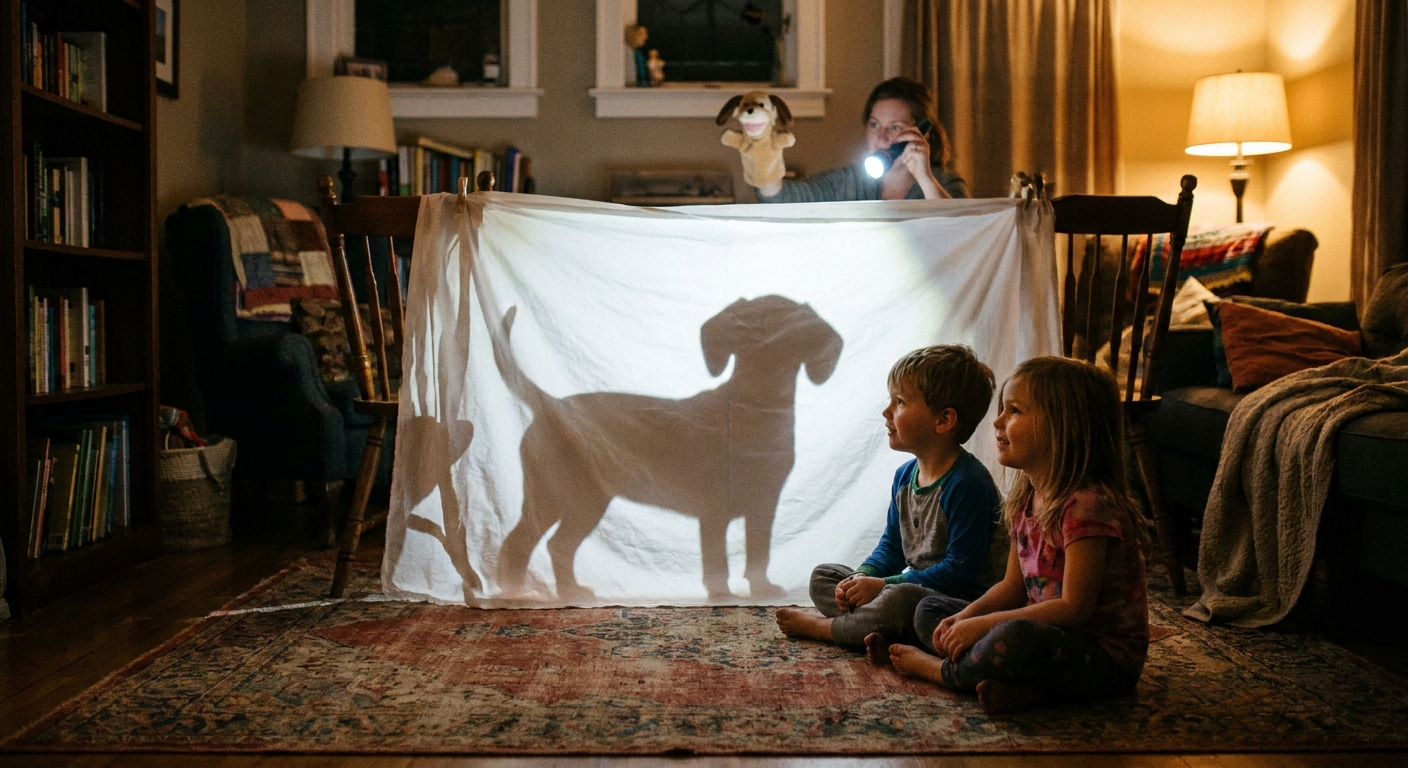
- Protect curious eyes. Set the flashlight so the beam points into the sheet, not into the room, and keep kids from peeking directly at it from backstage.
Troubleshooting
My shadows look fuzzy
- Move the puppet closer to the sheet.
- Pull the sheet tighter.
- Turn off nearby lamps so your flashlight is the main light source.
The stage is too dim
- Move the flashlight closer to the sheet.
- Use fresh batteries or switch to a brighter flashlight.
- Try a thinner fabric for your screen.
Kids keep walking in front of the screen
- Lay down a blanket “audience zone” and make it part of the theater rules.
- Give each child a job: puppet holder, sound maker, or line repeater.
My puppets keep bending
- Double the cardboard (two layers taped together).
- Use a wider handle like a paint stir stick or ruler.
Easy upgrades
Once your family has done one show, you might get enthusiastic requests for sequels. Here are low-effort ways to level up.
- Make a background strip: Cut a fence line, a hill, or a city skyline and tape it along the bottom edge of the screen.
- Create a puppet parking lot: Tape envelopes to the inside of a shoebox lid and label them with simple pictures (moon, cow, spider).
- Invite a guest narrator: Let a sibling read the rhyme while you move the puppets.
- Try a paper scene: If your kids love building a “world” for the rhyme, you can also make a tabletop backdrop with our paper song scene activity.
Calm bedtime rhymes
If your goal is a softer landing into sleep, choose rhymes with gentle images and fewer jumpy characters. I like to close with something slow and soothing, then move straight into pajamas and books.
If you want more truly calming bedtime music ideas beyond rhymes, our lullaby guide is here: The science of lullabies: 7 calming bedtime songs.
One last cozy reminder
Your first show does not need to be polished. A crooked sheet and a cow that looks suspiciously like a potato will still earn gasps, giggles, and that quiet little hush when the lights go low.
That is the whole point. You are making a memory with whatever is already in your house, right there in the living room.
For more rhyme ideas to build into playtime, you can browse our Nursery Rhymes guide.